
Italian food wholesale: buying from a wholesaler or direct from the producer
Share
If you run a deli, a farm shop, a wine shop or a small grocery, sourcing Italian food usually starts with one search and ends with three different answers: a wholesaler, a distributor, or the producer. They are not interchangeable. They differ on the minimum you have to commit, on how much shelf life arrives with the box, and on whether the shop down the road ends up selling exactly the same jar.
The three routes, plainly
Italian wholesalers and importers buy in Italy, hold stock locally and sell on to trade. You get logistics, paperwork and next-day availability, and you pay for that service. Their catalogue is built for volume, so minimum order quantities rarely suit a first trial.
Food distributors cover a territory with a fixed catalogue. Excellent for topping up fast movers; less useful for a line that sets you apart, because that catalogue is identical for every customer they have.
Buying direct from the producer removes one or two links. You keep that margin, you can trace the batch, and a small maker can agree an area arrangement with you. What you give up is instant availability: you order to a schedule instead of ringing on Tuesday for Wednesday.
“Italian wholesalers near me” — when the drive is worth it
A local cash and carry is hard to beat for pasta, passata, oil and standard tins: you see it, you take it, there is no carriage. The trade-off is choice. A wholesaler ranges on rate of sale, so small batches and seasonal lines are the first to be dropped — which is precisely the stock that makes a shelf worth walking to.
Price the trip honestly: two hours on the road, fuel, and either a closed shop or extra cover on the till. Spread over a small top-up, that cost per jar is often higher than any delivery charge.
Four questions before you list a new line
- What is the minimum unit per line, not per order? Testing four flavours in cases of twelve ties up 48 jars to answer a question that 24 would have answered.
- How much shelf life is left on delivery? Not the total life of the product: what remains when the box reaches you. Ask for it in writing on the order confirmation.
- Who is responsible for the labelling in your market? Ask directly whether the supplier provides labels that meet the requirements where you sell — in Great Britain the rules on the responsible food business address differ from those in the EU and in Northern Ireland. If the supplier does not provide compliant labels, the work falls to you before anything reaches the shelf.
- Who answers when something goes wrong? A named contact or a service desk. You find out the difference at the first short delivery, not in the first catalogue.
Test a line without tying up cash
A readable trial has four settings: three or four lines, the smallest case available, eight weeks on shelf, and a fixed position at eye level. Add a shelf card with the producer's name — an unfamiliar jar sells noticeably slower when nobody explains it, however good the contents.
Then measure three numbers rather than one: landed cost per jar (net price plus its share of carriage), the retail price your location supports, and the number of weeks a jar takes to sell. A high-margin line that takes three months to move earns less than a middling-margin line that clears in one.
What we make, and how to order
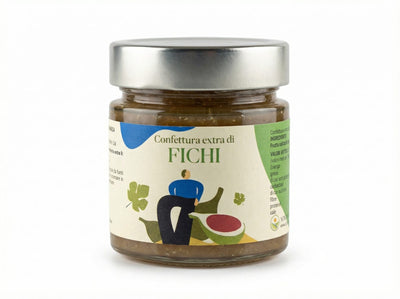
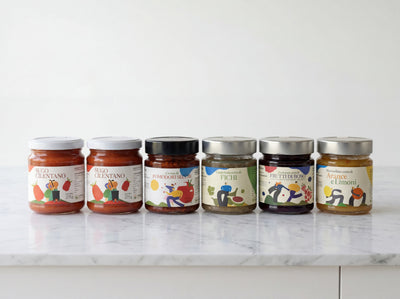
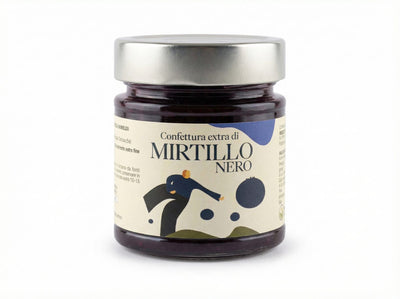
We are not a wholesaler. We are a farm in southern Italy that processes its own harvest: jams and marmalades in 212 g jars, antipasti, pâtés and vegetable creams in 200 g jars. No pectin, no thickeners, no preservatives or colourings — the set comes from vacuum cooking at low temperature. Our fig jam holds a WineHunter Award Gold and a Great Taste 2025 award.
We supply retailers directly, with no middleman: ask us for a trade price list and a sample case — tell us which lines you want to trial and the case size that suits your shelf. Area arrangements are open to discussion.