

Condiments
Rosehip jam: the recipe and how to clean rosehips
Rosehip is the last wild fruit of the year, and its jam is the most labor-intensive preparation of the season: not because of the cooking, which is brief, but because of what is inside the fruit. Behind the compact skin are hard seeds and a layer of irritating hairs, which must be removed completely. Here you will find the two cleaning methods, the quantities and the real yield.

Method
- Parti da cinorrodi raccolti dopo le prime gelate. Se non puoi aspettare, lava i frutti e tienili 48 ore a −18 °C in congelatore, poi lasciali scongelare: diventano più dolci e si puliscono molto meglio. Queste 48 ore non rientrano nei tempi della ricetta.
- Lava i cinorrodi ed elimina picciolo e coroncina nera, dove si annidano sporco e peluria. Non serve tagliarli.
- Mettili in pentola con l'acqua, circa 600 ml per chilo, e cuoci con il coperchio 35-45 minuti, finché non si disfano.
- Primo passaggio: passa tutto al passaverdura con il disco più grosso, oppure schiaccia con un mestolo dentro un colino. Restano indietro semi e bucce, ma non i peli.
- Sciacqua con acqua bollente setaccio, mestolo e ciotola. È il passaggio che quasi tutti saltano: senza, il feltro di peli formatosi al primo giro finisce nella polpa.
- Secondo passaggio: spingi la polpa attraverso un setaccio davvero fine, maglie da un millimetro o meno, oppure attraverso un telo di cotone piegato in due.
- Controlla il risultato: strofina un po' di polpa tra pollice e indice. Se senti filamenti rigidi, passala una terza volta.
- Pesa la polpa pulita: è quel peso, non quello dei frutti raccolti, a stabilire lo zucchero. Da 2 kg di cinorrodi ottieni circa 1 kg di polpa.
- Scalda piano la polpa con il succo di limone in una pentola alta, perché la massa è densa e schizza. Unisci lo zucchero mescolando finché ogni granello si è sciolto, prima del bollore.
- Cuoci 8-12 minuti mescolando sempre sul fondo: per via della densità questa confettura attacca prima di qualsiasi altra.
- Prova del piattino freddo: versa mezzo cucchiaino su un piattino tenuto in congelatore, aspetta 60 secondi e spingi con il dito. Se resta la grinza è pronta. Se è troppo densa, aggiungi un cucchiaio di acqua bollente per vasetto.
- Riempi i vasetti caldi fino a 5 mm dal bordo, pulisci il bordo con un panno bagnato e chiudi subito. Pastorizza 10 minuti in acqua bollente, lascia raffreddare e verifica che ogni capsula sia concava.
Minnelea products for this recipe
The preserves used in this recipe.
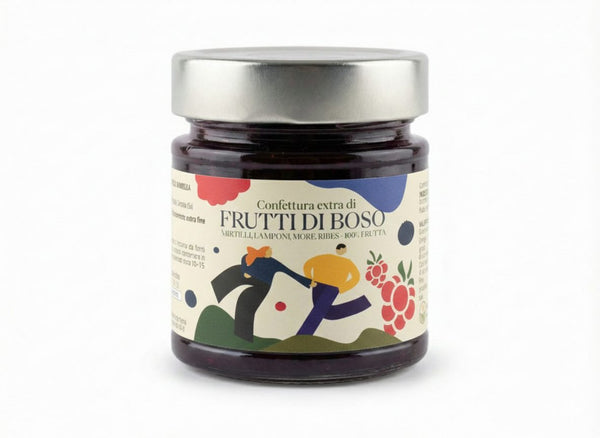
Minnelea
Extra Forest Berry Jam – Artisan, Preservative-Free
€8,90
Minnelea
Sweet Awakening Kit – 6 Artisan Jams
€39,00
• The point of the whole recipe: inside the rosehip, besides the hard seeds, there is a layer of short, stiff hairs - the same itching powder from schoolyards - and it must be removed completely. No cooking time makes it harmless: it is removed only mechanically. If it remains, the jar is not unpleasant, it is inedible, because the hairs irritate the throat for hours.
• Method 1, cleaning raw: wash the fruits, remove stem and black crown (that is exactly where dirt and hairs settle), cut each rosehip in half lengthwise and scoop out seeds and hairs with a small teaspoon or melon baller, working over a bowl. Then rinse the half skins in cold water, rubbing them between your fingers, and repeat: the detached hairs float. Plan 45 to 90 minutes per kilo. In exchange you get pieces of pulp instead of a smooth puree. Always wear gloves, do not touch your eyes, wash cutting board and knife well.
• Method 2, the one followed here: cooking and double passage through the sieve. It is faster and gives a smooth puree; method 1 is worth it only if you want pieces.
• Why the sieve must be passed twice: this is the point where almost every recipe slips. A wide-mesh sieve separates only seeds and skins from the pulp; the hairs are thinner than the mesh and the same color as the puree, so they pass through without you seeing them. Only a second pass, with a sieve of one millimeter or less or with a cotton cloth folded in two, holds them back. And between the two passes the sieve must be rinsed with boiling water, because during the first round a felt of hairs and fibers forms on the surface, which otherwise you push to the other side together with the pulp. Final check: rub a little pulp between thumb and index finger, and if you feel stiff filaments, pass it a third time.
• Where and when to gather: the fruit of dog rose is called rosehip. The plant grows wild along hedges, at woodland edges and in abandoned pastures, from sea level up to eighteen hundred meters. The season runs from September to late November, with the best moment at the end of October. Choose the largest fruits, which yield three or four times more pulp for the same cleaning work, deep red and just yielding under the thumb. Heavy gloves against thorns.
• Never along busy roads: exhaust dust and braking residues settle on the fruit and do not come off by washing. Stay a few dozen meters away, and avoid low branches along a beaten path, the edges of treated fields and slopes just weeded. In parks and reserves, gathering is regulated and on private land permission is needed. Leave most of them on the plant: rosehips are winter food for thrushes and blackbirds.
• The frost trick: a rosehip picked in early September is hard, woody and astringent, while after two or three nights below zero it is soft, darker and clearly sweeter, because ice crystals break the cell walls and much of the astringent sensation disappears. Those who do not want to wait for the first frost put the washed fruits 48 hours at −18 °C in the freezer and then let them thaw: the result is almost identical and thawed rosehips clean much better. Those 48 hours are not included in the recipe times.
• Pectin and sugar: rosehip contains enough pectin and its own acidity to set without added gelling agents, and the passed pulp is already dense on its own; gelling agent here would only make it rigid. Weigh the clean pulp and calculate on that weight from 40 to 50 percent sugar, that is 400-500 g per kilo: at 40 percent the fruit is clearer, at 50 the jar lasts longer, below 35 it stays runny and keeps poorly. The juice of one and a half lemons per kilo of pulp is more for freshness and color than for setting.
• This jam thickens quite a lot as it cools, so it is better to stop one minute early. And because of its density, it sticks to the bottom sooner than any other: always stir while scraping the bottom, in a tall pot because the mass splashes.
• The real yield, and it is the lowest of all: from 1 kg fresh rosehips, about 950 g remain after removing stems and crowns, about 500 g clean pulp after cleaning and sieving, and 2-2,5 finished jars of 230 g. Seeds and hairs weigh almost half the fruit. For two full jars you need one kilo of fruit and an hour and a half of work: knowing it beforehand turns disappointment into a choice. Those who want more can extend the pulp with grated apple or blackberries.
• The mistakes that repeat most often: sieving only once, by far the most serious because the jar becomes unusable; not rinsing the sieve between the two passes; gathering too early, when the fruits are still hard and astringent; cooking too long, so what looked perfect in the pot is a paste the next day; gathering along the road, because a free fruit is not therefore a clean fruit.
• Beyond jam, the clean pulp is the base for almost everything: syrup (diluted with the same amount of water, drained overnight in a cloth and cooked with 500 g sugar per liter), an autumn sauce for duck or venison, or a chutney with onion, apple cider vinegar and ginger beside an aged cheese. For an infusion, dry only the already cleaned half skins and filter with a fine strainer. From a composition standpoint, rosehip is known as one of the fruits with the highest vitamin C content, of which cooking degrades a good part: it is a nutritional fact of the fresh fruit, not a property of the jar.
• Storage: the jars must be clean and warm, 20 minutes in the oven at 120 °C, always with new lids. After filling, pasteurize 10 minutes in boiling water: with a fruit that is not sharply acidic, it is safer than simply turning the jars upside down. Closed, cool and dark, they hold 8-12 months, and the color darkens during the year: this is normal. Once opened, refrigerate and consume within three weeks. Allergens: none in the basic ingredients.
• Honest note: we do not make rosehip jam. It is not in our range and it is not a fruit from our hills in Cilento, and it almost always remains a home preparation, easier to find at a village market than on a shelf. If you are looking for something with the same dark, wild imprint, our Extra Mixed Berry Jam is the closest. But hedge rosehips are something you make yourself.
A Minnelea recipe built around Extra Mixed Berry Jam: low-temperature vacuum cooking, real fruit and short ingredients, with no added pectins and no preservatives.
• Method 1, cleaning raw: wash the fruits, remove stem and black crown (that is exactly where dirt and hairs settle), cut each rosehip in half lengthwise and scoop out seeds and hairs with a small teaspoon or melon baller, working over a bowl. Then rinse the half skins in cold water, rubbing them between your fingers, and repeat: the detached hairs float. Plan 45 to 90 minutes per kilo. In exchange you get pieces of pulp instead of a smooth puree. Always wear gloves, do not touch your eyes, wash cutting board and knife well.
• Method 2, the one followed here: cooking and double passage through the sieve. It is faster and gives a smooth puree; method 1 is worth it only if you want pieces.
• Why the sieve must be passed twice: this is the point where almost every recipe slips. A wide-mesh sieve separates only seeds and skins from the pulp; the hairs are thinner than the mesh and the same color as the puree, so they pass through without you seeing them. Only a second pass, with a sieve of one millimeter or less or with a cotton cloth folded in two, holds them back. And between the two passes the sieve must be rinsed with boiling water, because during the first round a felt of hairs and fibers forms on the surface, which otherwise you push to the other side together with the pulp. Final check: rub a little pulp between thumb and index finger, and if you feel stiff filaments, pass it a third time.
• Where and when to gather: the fruit of dog rose is called rosehip. The plant grows wild along hedges, at woodland edges and in abandoned pastures, from sea level up to eighteen hundred meters. The season runs from September to late November, with the best moment at the end of October. Choose the largest fruits, which yield three or four times more pulp for the same cleaning work, deep red and just yielding under the thumb. Heavy gloves against thorns.
• Never along busy roads: exhaust dust and braking residues settle on the fruit and do not come off by washing. Stay a few dozen meters away, and avoid low branches along a beaten path, the edges of treated fields and slopes just weeded. In parks and reserves, gathering is regulated and on private land permission is needed. Leave most of them on the plant: rosehips are winter food for thrushes and blackbirds.
• The frost trick: a rosehip picked in early September is hard, woody and astringent, while after two or three nights below zero it is soft, darker and clearly sweeter, because ice crystals break the cell walls and much of the astringent sensation disappears. Those who do not want to wait for the first frost put the washed fruits 48 hours at −18 °C in the freezer and then let them thaw: the result is almost identical and thawed rosehips clean much better. Those 48 hours are not included in the recipe times.
• Pectin and sugar: rosehip contains enough pectin and its own acidity to set without added gelling agents, and the passed pulp is already dense on its own; gelling agent here would only make it rigid. Weigh the clean pulp and calculate on that weight from 40 to 50 percent sugar, that is 400-500 g per kilo: at 40 percent the fruit is clearer, at 50 the jar lasts longer, below 35 it stays runny and keeps poorly. The juice of one and a half lemons per kilo of pulp is more for freshness and color than for setting.
• This jam thickens quite a lot as it cools, so it is better to stop one minute early. And because of its density, it sticks to the bottom sooner than any other: always stir while scraping the bottom, in a tall pot because the mass splashes.
• The real yield, and it is the lowest of all: from 1 kg fresh rosehips, about 950 g remain after removing stems and crowns, about 500 g clean pulp after cleaning and sieving, and 2-2,5 finished jars of 230 g. Seeds and hairs weigh almost half the fruit. For two full jars you need one kilo of fruit and an hour and a half of work: knowing it beforehand turns disappointment into a choice. Those who want more can extend the pulp with grated apple or blackberries.
• The mistakes that repeat most often: sieving only once, by far the most serious because the jar becomes unusable; not rinsing the sieve between the two passes; gathering too early, when the fruits are still hard and astringent; cooking too long, so what looked perfect in the pot is a paste the next day; gathering along the road, because a free fruit is not therefore a clean fruit.
• Beyond jam, the clean pulp is the base for almost everything: syrup (diluted with the same amount of water, drained overnight in a cloth and cooked with 500 g sugar per liter), an autumn sauce for duck or venison, or a chutney with onion, apple cider vinegar and ginger beside an aged cheese. For an infusion, dry only the already cleaned half skins and filter with a fine strainer. From a composition standpoint, rosehip is known as one of the fruits with the highest vitamin C content, of which cooking degrades a good part: it is a nutritional fact of the fresh fruit, not a property of the jar.
• Storage: the jars must be clean and warm, 20 minutes in the oven at 120 °C, always with new lids. After filling, pasteurize 10 minutes in boiling water: with a fruit that is not sharply acidic, it is safer than simply turning the jars upside down. Closed, cool and dark, they hold 8-12 months, and the color darkens during the year: this is normal. Once opened, refrigerate and consume within three weeks. Allergens: none in the basic ingredients.
• Honest note: we do not make rosehip jam. It is not in our range and it is not a fruit from our hills in Cilento, and it almost always remains a home preparation, easier to find at a village market than on a shelf. If you are looking for something with the same dark, wild imprint, our Extra Mixed Berry Jam is the closest. But hedge rosehips are something you make yourself.
A Minnelea recipe built around Extra Mixed Berry Jam: low-temperature vacuum cooking, real fruit and short ingredients, with no added pectins and no preservatives.