

I prodotti offerti sono caratterizzati da freschezza, genuinità e un sapore eccezionale. La qualità elevata e l'autenticità degli ingredienti garantiscono un'esperienza culinaria di alto livello. Consiglio vivamente di provarli!
Condiments
Fig jam: the recipe with fresh figs
A ripe fig has a two-day margin: when two kilos arrive all at once, jam is the answer. This recipe explains why lemon is not optional here, how much sugar is really needed with a fruit that is already sweet and poor in pectin, and how to recognize the right point with the cold-plate test.

Method
- Lava i fichi velocemente e asciugali: in ammollo assorbono acqua. Togli il picciolo duro ed elimina ciò che è spaccato o già in fermentazione, perché un fico inacidito rovina l'intera pentola.
- Taglia i fichi in quarti, in ottavi quelli grandi. Pesali solo adesso: è su questo peso netto che calcoli lo zucchero.
- Mescola i fichi con lo zucchero, metà del succo di limone e la mela grattugiata in una pentola larga e bassa. Lascia macerare 4 ore a temperatura ambiente, meglio tutta la notte in frigorifero: questo tempo non è conteggiato nei minuti indicati.
- Scalda piano finché lo zucchero è completamente sciolto, perché se al bollore è ancora granuloso ricristallizza nel vasetto. Poi porta a bollore e togli con una schiumarola la schiuma chiara.
- Cuoci da 40 a 55 minuti a fuoco medio-alto raschiando spesso il fondo, soprattutto nell'ultimo quarto d'ora: per via dello zucchero già presente nel frutto, la confettura di fichi attacca prima di quasi ogni altra.
- Se la vuoi più liscia, dai tre colpi brevi di frullatore a immersione a metà cottura. I semini del fico sono piccoli e morbidi e non rilasciano amaro.
- Aggiungi il resto del succo di limone e, se li usi, vaniglia, timo o zenzero soltanto negli ultimi 5 minuti di cottura.
- Fai la prova del piattino freddo: mezzo cucchiaino di confettura su un piattino tenuto in freezer, 60 secondi di attesa, poi spingi con il dito. Se resta una grinza è pronta, se cola come sciroppo prosegui 5 minuti e ripeti con un piattino nuovo. Prova il liquido tra i pezzi, non il pezzo di frutto.
- Invasetta subito nei vasetti sterilizzati e ancora caldi, riempiendo fino a 5 mm dal bordo. Pulisci il bordo con un panno imbevuto di acqua bollente, chiudi con capsule nuove e pastorizza i vasetti 10 minuti in acqua bollente, poi falli raffreddare.
Minnelea products for this recipe
The preserves used in this recipe.
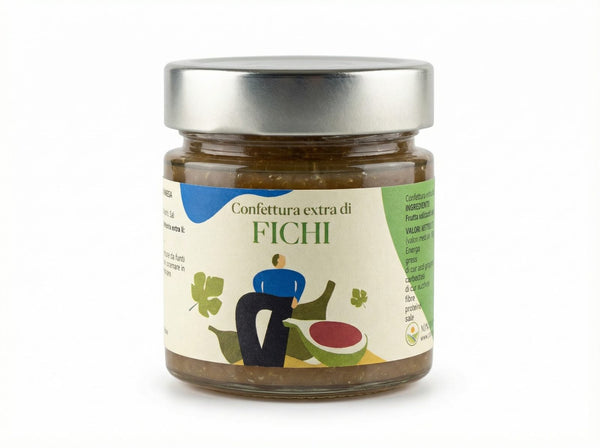
Minnelea
Extra White Fig Jam – Award-Winning Artisan, Preservative-Free
€7,90
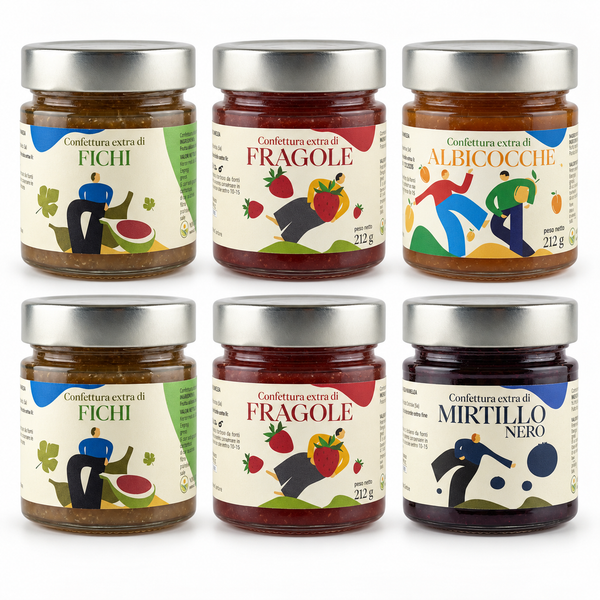
Minnelea
Sweet Awakening Kit – 6 Artisan Jams
€39,00
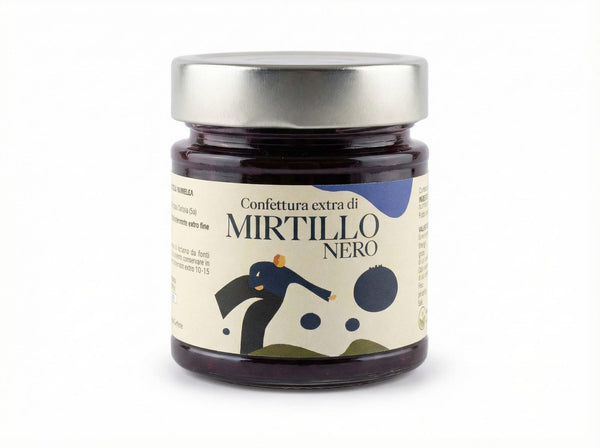
Minnelea
Extra Black Blueberry Jam – Award-Winning Artisan
€8,90
• Skin yes or no: almost all fig pectin is in the skin and in the layer just underneath, and in black and purple figs all the color is there too. Keeping it gives you more gelling power and a dark red jar, provided you cut finely - small figs into quarters, large ones into eighths - otherwise little skins remain in the mouth. Without skin, the jam is smoother, lighter and more elegant beside cheese, but it needs 10-15 more minutes of cooking and the yield drops: it only makes sense with late figs with tough skin.
• To peel them, the shortcut is blanching: 30 seconds in boiling water, immediately into water and ice, then the skin comes away with your thumb. When in doubt, keep the skin and cut finely: you need all the pectin.
• Lemon is not optional here. Fig is the most difficult pantry fruit for two reasons that add up: it contains very little pectin, much less than apple, quince or currants, and almost no acid. A ripe fig is around pH 5, well above the roughly 3,5 that pectin needs to form a network. Lemon juice lowers the pH to the gelling threshold and cuts the fruit’s flat sweetness: count the juice of two lemons per net kilo, twice as much as almost any other fruit. It is not a matter of taste but of chemistry. To be safe, add one grated tart apple with its skin for every kilo.
• The fruit-sugar ratio is counterintuitive: figs are already sweet on their own and it feels natural to use little sugar, but 40-45 percent of net weight is the minimum threshold that works, because with a fruit so poor in pectin, sugar binds water and helps build the gel. Below 35 percent the jam stays runny and keeps poorly. At 40 percent you get a fruity jar that lasts eight months, at 50 percent a more compact version that reaches a year; above 60 percent the fruit disappears.
• The 4-hour maceration, better overnight in the refrigerator, is not included in the indicated times: sugar draws water out of the fruit and saves about ten minutes of cooking, which means more aroma. Do not work more than 2 kilos at a time, because large quantities cook too long and lose aroma, and use a wide, low pot: more evaporation surface, fewer minutes on the heat.
• Cold-plate test: put three small plates in the freezer before starting, pour half a teaspoon of jam onto the chilled plate, wait 60 seconds and push with your finger. If a wrinkle remains, it is ready; if it runs like syrup, continue 5 minutes and repeat with a new plate. Here the thermometer guarantees nothing, because there is too little acid and too little pectin. And watch the reverse trap: in the pot, fig jam looks denser than it is, so test the liquid between the pieces, not the piece of fruit.
• Fig seeds are small and soft and do not release bitterness, unlike grape or blackberry seeds: if you want a smoother consistency, you can give three short pulses with a stick blender halfway through cooking without risking astringent aftertastes.
• Variation with gelling sugar: for 1,4 kg figs you need 700 g 1:2 gelling sugar, or 1,4 kg 1:1 for a firmer result, plus the juice of one lemon. Mix, let rest one hour, bring to a boil and cook exactly 4 minutes, stirring continuously. You gain certainty - apple pectin and citric acid are already inside - and color and aroma closer to raw fruit. You lose depth: that almost caramelized note is born during long reduction and does not arrive in four minutes. The consistency is firmer, it cuts instead of flowing, and many 1:2 and 1:3 gelling sugars contain sorbic acid as a preservative.
• Variation with dried figs, to make it out of season: 500 g dried figs cut into quarters and without stems, 750 ml water (or 600 ml water and 150 ml orange juice), 250 g sugar and no more because dried figs are already concentrated sugar, the juice of 2 lemons, and, if desired, a cinnamon stick or star anise. Soak 8-12 hours in cold water, or simmer 30 minutes if you are in a hurry; cook 20-25 minutes in the soaking water until very soft, mash or blend, add sugar and lemon and continue another 20-25 minutes. This version thickens faster than fresh fig jam, so test earlier. Yield: about 4 jars of 230 g. It is not an imitation of the fresh version: it is darker, with a date and caramel base.
• The five most common mistakes: too little lemon, by far the most serious, because one lemon per kilo is enough with strawberries but not with figs; turning off too early, because the fruit pieces suggest a density that is not there yet; high heat at the end, when the jam sticks in an instant and that burnt caramel does not go away; hot product poured into cold jars, with glass cracking and vacuum not forming; figs already in fermentation, because the alcoholic or vinegary smell does not cook away.
• Storage: sterilize the jars first, 20 minutes in the oven at 120 °C, and always use new lids. Fill to 5 mm from the rim, clean the rim with a cloth soaked in boiling water and close immediately, then pasteurize 10 minutes in boiling water: with a fruit so low in acid, it is safer than simply turning the jars upside down. Closed and kept in the dark, they last 8-12 months; once opened, refrigerate and finish within 3 weeks, the honest price of little sugar and no preservatives. When opened, the lid must pop: if it does not, discard the jar.
• Allergens: none. Only fruit, sugar and lemon juice, gluten-free, dairy-free and nut-free.
• Aromatic variations: fig handles strong pairings well - port, ginger and orange, or vanilla and thyme - always added in the last minutes of cooking, when the heat no longer has time to flatten them. And set aside one jar until December: after two months, fig jam becomes rounder.
• Pairing: it works on bread, but it does its best on a cheese board. One teaspoon next to aged pecorino, mature caciocavallo or blue cheese: it should accompany, not cover.
A Minnelea recipe built around Extra Fig Jam: we make it with white Cilento Dottato figs, cooked under vacuum at low temperature, where water evaporates without the fruit ever reaching 100 °C, with no added pectin and no preservatives. That jar won a WineHunter Award Gold and a Great Taste 2025.
• To peel them, the shortcut is blanching: 30 seconds in boiling water, immediately into water and ice, then the skin comes away with your thumb. When in doubt, keep the skin and cut finely: you need all the pectin.
• Lemon is not optional here. Fig is the most difficult pantry fruit for two reasons that add up: it contains very little pectin, much less than apple, quince or currants, and almost no acid. A ripe fig is around pH 5, well above the roughly 3,5 that pectin needs to form a network. Lemon juice lowers the pH to the gelling threshold and cuts the fruit’s flat sweetness: count the juice of two lemons per net kilo, twice as much as almost any other fruit. It is not a matter of taste but of chemistry. To be safe, add one grated tart apple with its skin for every kilo.
• The fruit-sugar ratio is counterintuitive: figs are already sweet on their own and it feels natural to use little sugar, but 40-45 percent of net weight is the minimum threshold that works, because with a fruit so poor in pectin, sugar binds water and helps build the gel. Below 35 percent the jam stays runny and keeps poorly. At 40 percent you get a fruity jar that lasts eight months, at 50 percent a more compact version that reaches a year; above 60 percent the fruit disappears.
• The 4-hour maceration, better overnight in the refrigerator, is not included in the indicated times: sugar draws water out of the fruit and saves about ten minutes of cooking, which means more aroma. Do not work more than 2 kilos at a time, because large quantities cook too long and lose aroma, and use a wide, low pot: more evaporation surface, fewer minutes on the heat.
• Cold-plate test: put three small plates in the freezer before starting, pour half a teaspoon of jam onto the chilled plate, wait 60 seconds and push with your finger. If a wrinkle remains, it is ready; if it runs like syrup, continue 5 minutes and repeat with a new plate. Here the thermometer guarantees nothing, because there is too little acid and too little pectin. And watch the reverse trap: in the pot, fig jam looks denser than it is, so test the liquid between the pieces, not the piece of fruit.
• Fig seeds are small and soft and do not release bitterness, unlike grape or blackberry seeds: if you want a smoother consistency, you can give three short pulses with a stick blender halfway through cooking without risking astringent aftertastes.
• Variation with gelling sugar: for 1,4 kg figs you need 700 g 1:2 gelling sugar, or 1,4 kg 1:1 for a firmer result, plus the juice of one lemon. Mix, let rest one hour, bring to a boil and cook exactly 4 minutes, stirring continuously. You gain certainty - apple pectin and citric acid are already inside - and color and aroma closer to raw fruit. You lose depth: that almost caramelized note is born during long reduction and does not arrive in four minutes. The consistency is firmer, it cuts instead of flowing, and many 1:2 and 1:3 gelling sugars contain sorbic acid as a preservative.
• Variation with dried figs, to make it out of season: 500 g dried figs cut into quarters and without stems, 750 ml water (or 600 ml water and 150 ml orange juice), 250 g sugar and no more because dried figs are already concentrated sugar, the juice of 2 lemons, and, if desired, a cinnamon stick or star anise. Soak 8-12 hours in cold water, or simmer 30 minutes if you are in a hurry; cook 20-25 minutes in the soaking water until very soft, mash or blend, add sugar and lemon and continue another 20-25 minutes. This version thickens faster than fresh fig jam, so test earlier. Yield: about 4 jars of 230 g. It is not an imitation of the fresh version: it is darker, with a date and caramel base.
• The five most common mistakes: too little lemon, by far the most serious, because one lemon per kilo is enough with strawberries but not with figs; turning off too early, because the fruit pieces suggest a density that is not there yet; high heat at the end, when the jam sticks in an instant and that burnt caramel does not go away; hot product poured into cold jars, with glass cracking and vacuum not forming; figs already in fermentation, because the alcoholic or vinegary smell does not cook away.
• Storage: sterilize the jars first, 20 minutes in the oven at 120 °C, and always use new lids. Fill to 5 mm from the rim, clean the rim with a cloth soaked in boiling water and close immediately, then pasteurize 10 minutes in boiling water: with a fruit so low in acid, it is safer than simply turning the jars upside down. Closed and kept in the dark, they last 8-12 months; once opened, refrigerate and finish within 3 weeks, the honest price of little sugar and no preservatives. When opened, the lid must pop: if it does not, discard the jar.
• Allergens: none. Only fruit, sugar and lemon juice, gluten-free, dairy-free and nut-free.
• Aromatic variations: fig handles strong pairings well - port, ginger and orange, or vanilla and thyme - always added in the last minutes of cooking, when the heat no longer has time to flatten them. And set aside one jar until December: after two months, fig jam becomes rounder.
• Pairing: it works on bread, but it does its best on a cheese board. One teaspoon next to aged pecorino, mature caciocavallo or blue cheese: it should accompany, not cover.
A Minnelea recipe built around Extra Fig Jam: we make it with white Cilento Dottato figs, cooked under vacuum at low temperature, where water evaporates without the fruit ever reaching 100 °C, with no added pectin and no preservatives. That jar won a WineHunter Award Gold and a Great Taste 2025.