
White Dottato figs: characteristics, season and kitchen uses
The white Dottato fig is a variety of Ficus carica grown across southern Italy. «White» refers to the pale skin, green turning yellow. The flesh is amber.
In Campania, Dottato is also grown in the Cilento, where our farm is based. Here you will find the two harvests, the season, drying and uses in the kitchen.
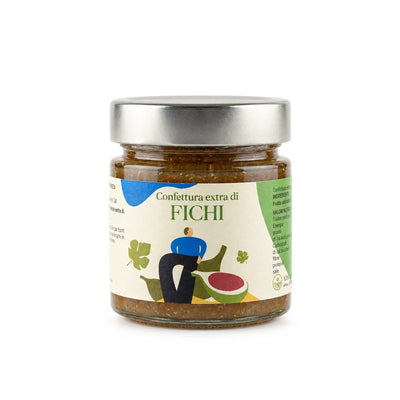
 | From our selection Fig JamHandmade, no preservatives. € 7,90 Discover → |
Two harvests: fioroni and forniti
Dottato bears fruit twice a year, and the two harvests are different.
Fioroni
They form from the previous year's buds, overwinter on the branch and ripen first, in June and July. They are large, with plenty of watery flesh: they are eaten fresh.
Forniti
They are the main harvest: we pick them from late July to September. They grow on the current year's shoots, are smaller and have denser flesh.
These are the figs that get dried or made into jam: with less water to evaporate, they hold up well to processing.
They also work in savoury dishes: here are the pairings of figs with cheese and cured meats.
The season
- June and July: fioroni, to eat fresh.
- Late July to September: forniti, the main harvest.
- October to spring: no fresh figs, only dried or as jam.
Fresh figs keep for only a few days. That is why, to have them after summer, they are dried or cooked.
Sun drying
Before refrigerators, drying figs was the way to have them all year round.
- They are picked very ripe, when they start to wilt on the tree.
- They are laid whole or split on cane racks, which let the air through.
- They stay in the sun for a few days and are brought in at night, so they do not take on the night's humidity.
- They are stored in a dry, airy place.
A white film often forms on dried figs: it is usually sugar that has come to the surface. If it is fluffy or patchy, it is mould. In the south they are also stuffed with a walnut or an almond.
Uses in the kitchen
Fresh
Eat them on their own at the end of a meal, or with aged pecorino, fresh goat's cheese or a blue cheese. You can also wrap them in a slice of cured ham.
Dried
They go into bakes and fillings, together with walnuts and almonds. Sliced, they work on a winter salad of radicchio and walnuts.
As jam
The jam goes on bread at breakfast, into tarts and alongside cheese, especially aged pecorino. You will find ideas in our guide on how to use fig jam.
How to choose them
- Fresh: soft to the touch but not mushy, with the stem intact. Small cracks in the skin show they are ripe.
- Dried: soft skin and even colour. Check the ingredient list on the label.
- As jam: look at the grams of fruit per 100 g and the ingredient list.
From tree to jar
We make our extra fig jam with white Dottato figs, cane sugar, lemon juice and infused vanilla. For 100 g of jam we use 88 g of figs.
We cook it under vacuum at 55 °C, without adding pectin and with no preservatives. With this jam we won the Great Taste Award in 2025 and the WineHunter Award Gold in 2024.