
Forgotten fruit: rare and ancient varieties that produce the best jams
Supermarkets have impoverished our fruit
If you walk into a supermarket today to buy apples, you’ll likely find Golden, Fuji and Gala. Perhaps a Granny Smith. Out of the hundreds of ancient varieties cultivated in Italy for centuries, mass retail has selected only a handful—those that keep longest, survive transport, look perfectly uniform. Flavour came last.
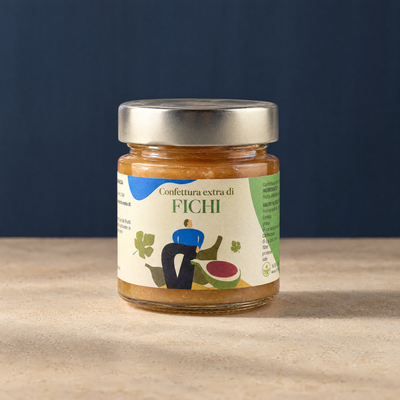
 | From our selection Fig JamHandmade, no preservatives. € 7,90 Discover → |
For fruit destined to become confettura, this selection has been especially damaging. The best varieties for preserving are often the least suited to mass distribution: too delicate, too irregular, too quick to ripen. Yet it is precisely these traits that give rise to extraordinary confetture.
Cilento figs: not all are created equal
When it comes to figs, variety makes a world of difference. In Cilento several types coexist, each with its own personality:
- Fico bianco del Cilento: the area’s most renowned cultivar, with pale, honeyed flesh. Harvested in late August and September, it is ideal for dense, amber confetture
- Fico nero: deeper in colour and flavour, with almost caramel notes. It yields darker confetture and a different aromatic complexity
- Fico dottato: widespread across southern Italy, excellent both fresh and transformed
The final quality of the confettura depends on the fruit’s ripeness at harvest. Figs picked too early give a bitter, muted preserve. Those gathered at peak maturity—soft to the touch, almost translucent beneath the skin—become confetture that taste like condensed summer sunshine.
Ancient pears: Coscia, Martin Sec, Butirra
Today’s common pear varieties have been bred for shelf life. But ancient pears—Coscia, Martin Sec, Butirra—offer completely different flavours: more layered, more fragrant, a sweetness that lingers rather than shouts. Turned into confettura, they surpass anything a Conference or Williams can deliver.
Southern apricots: when less water means more flavour
Southern Italian apricots, grown in hot, scarcely irrigated zones, carry less water and more sugar than fruit from northern Italy or northern Europe. This makes them ill-suited to distribution—they bruise easily and fade fast—but perfect for confettura. The finished preserve possesses an aromatic concentration no juicier variety can match.
Seasonality as a mark of quality
Behind every exceptional confettura lies a seasonal choice. The finest artisanal batches are made with fruit picked at its precise moment—not rushed, not delayed—and processed within days. It is this narrow window, often just a few weeks each year, that gives the preserve its character.
Choosing an artisanal confettura that declares the fruit variety is already a sign of respect: it tells you the maker understands the importance of raw material and refuses to hide behind a generic “fig confettura”.