
Strawberry Confettura: History, Tradition and Craft of an Italian Classic
Strawberry confettura is one of the most beloved jars in Italian kitchens, yet also one of the most misunderstood. Often wrongly called "marmellata", confused with composta, or lumped together with gelée, it has lived for centuries amid misconceptions. Re-tracing its history is worth the effort, because understanding where a jar of confettura comes from explains why some taste of real strawberry while others recall chewy candy.
 | From our selection Strawberry JamHandmade, no preservatives. € 7,90 Discover → |
This article is a map: it starts with the first Renaissance "composte", moves through the Industrial Revolution that transformed fruit preservation on a European scale, and arrives at the EU regulation that today dictates what we may legally call confettura. Along the way we discover how a seemingly simple preparation—fruit, sugar, heat—is in reality a delicate balance of agriculture, technique and culture.
The strawberry arrived late on Italian tables
The strawberries we find in shops today have little in common with those the ancient Romans ate. Pliny the Elder mentions a wild fragaria, tiny and intensely fragrant, gathered in the woods: it was Fragaria vesca, the woodland strawberry, still found in Italian undergrowth—famous is the one from Nemi in the Roman Castles.
The strawberry we now consider "classic"—large, juicy, deep red—was born much later, almost by accident. In 1714 a French officer stationed in Chile, Amédée-François Frézier, brought specimens of Fragaria chiloensis back to Europe. Crossed with the North-American Fragaria virginiana already present in French gardens, it produced Fragaria × ananassa, the species from which virtually all cultivated varieties descend.
In Italy its spread was gradual: the cultivated strawberry entered 19th-century agronomic treatises but long remained a niche, expensive fruit, seen as delicate and short-season. Only the combination of greenhouse growing, refrigeration and railway, between the late 1800s and early 1900s, carried it to markets throughout the peninsula and made it an accessible raw material for home and later industrial preserves.
From Renaissance "composte" to modern confettura
The idea of preserving fruit by cooking it with sugar is ancient. Renaissance cookery treatises, from Maestro Martino’s Libro de Arte Coquinaria onward, describe composte of various fruits—quinces, plums, pears, cherries—made with honey or, after cane sugar arrived on a European scale, with sucrose.
The word "marmellata" comes from the Portuguese marmelo, quince: it originally denoted the quince preserve brought to Europe by Lusitanian merchants. For centuries "marmellata" and "composta" were used interchangeably, and every region had its own terms.
Strawberry entered this universe as a "minor" raw material compared with classic quinces, damsons plums and cherries, because it has three technical drawbacks for processors: low pectin (so it gels reluctantly), high water (so it needs long cooking to concentrate), and delicate pigments (so it "fades" if overheated). For centuries strawberry confettura was an exercise in patience that few performed really well.
The Industrial Revolution and the birth of "shelf-ready" confettura
In the 19th century fruit preservation changed face. Nicolas Appert, a Frenchman, patented in 1809 the system of heat sterilisation in sealed glass jars: the birth of the modern canning industry. In the same years the industrial extraction of pectin from apples and citrus allowed gelling of confetture even from pectin-poor fruit such as strawberry.
The result, throughout the 20th century, was an industrial product standard that learned to use frozen or concentrated fruit instead of fresh, add industrial pectin for predictable texture, add citric acid to adjust pH, cook at high temperature for short times (rapid boils at 100–105 °C), and add colourings, flavourings and sometimes concentrated juices of other fruit to "boost" flavour.
This model allowed strawberry confettura to become an inexpensive, homogeneous product, always identical to itself. It also erased from the palate of entire generations the real taste of cooked strawberry: that specific, faintly herbaceous perfume, never cloying, obtained only when the fruit is truly at the centre of the preparation.
What the law says today: Regulation (EC) 2001/113
In Europe "confettura" is not a free word. Regulation (EC) 2001/113, transposed into Italy by Legislative Decree 50/2004, states precisely what we may legally call confettura, marmellata, jelly or chestnut cream.
For strawberry two definitions apply: Confettura, a mixture brought to a suitable gelled consistency, of sugars and pulp or purée of one or more species of fruit, with a quantity of pulp or purée used in the manufacture of 1 kg of finished product not less than 350 g in general; Extra confettura, same definition, but with a quantity of pulp or purée not less than 450 g per 1 kg of finished product.
The word "marmellata", in the legal sense, is reserved in the EU for citrus preserves. Technically, strawberry marmellata does not exist: it is called confettura. Italian commerce often overlooks the point—also because in everyday speech "marmellata" means any fruit preserve—but labels must respect it.
General rules on nutrition labelling (Reg. EU 1169/2011) and on claims (Reg. EC 1924/2006) also apply to confetture, requiring caution in attributing any health property to the product.
Craft confettura: what really changes
Between a well-made artisanal confettura and an average industrial one the difference is not a detail: it is a method. Three main technical knots.
Real fruit, not purée. An artisanal confettura starts with whole or broken strawberries, handled quickly after harvest. An industrial one often starts from concentrated purée or frozen fruit: the flavour is clean but generic, the field aroma lost along the supply chain.
Slow, temperature-controlled cooking. The subtlest and most decisive difference. Cooking strawberry at lower temperatures and for calibrated times allows water to concentrate without destroying anthocyanin pigments (those that give the red) and volatile aromas. A rapid boil at 105 °C reaches the same sugar concentration but leaves a cooked-burnt note that is the hallmark of low-grade industrial confettura.
Few ingredients. A well-made artisanal confettura has three or four ingredients: strawberries, sugar, lemon juice, possibly fruit pectin. That’s it. No colourings, no added flavours, no citric acid, no preservatives.
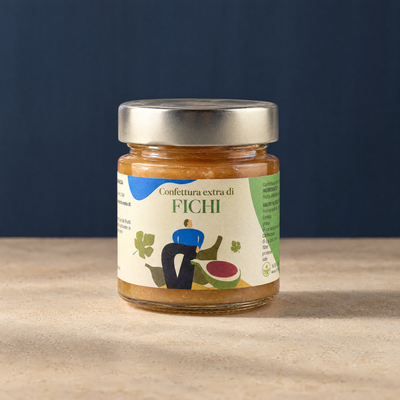
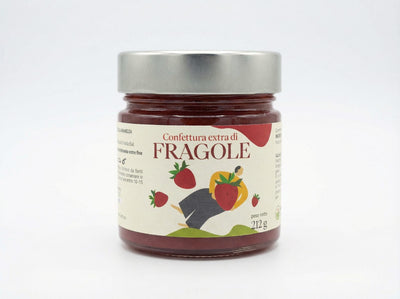
The Minnelea strawberry confettura works exactly on these three knots: real fruit from Cilento, low-temperature cooking, short ingredient list.
Confettura in Cilento: a tradition of transformation
Cilento is agricultural land before it is gastronomic. Its history is one of poor soils, the need to store summer fruit for lean months, of domestic practices handed from grandmother to grandchild. In this context confettura was never a luxury: it was a technical solution to seasonality.
Cilentan households still keep a small winter pantry of jars: figs, plums, pears, cherries, strawberries when the garden allows. In recent years this domestic tradition has met the movement of certified small-scale farming, which began bringing to market jars that keep the logic of home preserves—few ingredients, slow cooking—but with the technical rigour of an HACCP laboratory.
It is within this frame that our production sits: jars conceived as a chef’s farm pantry, to be used in professional and domestic kitchens for what they are—real fruit, cooked gently.
How to recognise a well-made strawberry confettura
Four visual and sensory clues allow you to judge a jar:
- Colour: a good confettura shows a variable, never uniform red, shading from garnet to ruby. A perfectly even, neon red betrays colourings or aggressive industrial cooking.
- Presence of pieces: even in a creamy confettura there must be traces of fruit—visible seeds, fragments of pulp, texture changes on the spoon. A totally smooth confettura is almost always an industrial purée.
- Aroma: on opening the jar a recognisable scent of fresh strawberry should emerge, with faint herbaceous notes. If sugar dominates or you detect "gummy" notes, the cooking was too long or too harsh.
- Ingredient list: the shorter the better. Fruit, sugar, lemon juice, fruit pectin. Stop.
FAQ
Are confettura and marmellata the same thing?
No. In the European Union, by law (Reg. EC 2001/113), the word "marmellata" is reserved for citrus preserves. Other fruits are called confetture.
What is the difference between confettura and extra confettura?
Extra confettura contains at least 450 g of fruit pulp or purée per kg of finished product; standard confettura at least 350 g.
Does strawberry confettura contain additives?
It depends on the producer. Industrial confetture may contain added pectin, citric acid, sometimes flavourings. Well-made artisanal ones have a very short list: fruit, sugar, lemon juice, possibly fruit pectin.
How long does an opened jar of confettura last?
Once opened, keep the jar in the refrigerator and consume within roughly 2–3 weeks.
Does Minnelea strawberry confettura contain pectin?
The pectin used is fruit pectin, not industrial, in the minimum dose needed to obtain the right texture without over-extending the cooking.
"Real fruit, cooked gently." It is more than a tagline: it is the summary of a technique and a choice. If you are curious about how we make our jars, start with the strawberry confettura from Cilento.