
Strawberry Varieties Grown in Italy: A Complete Guide
In any given supermarket, come spring, a strawberry is simply “a strawberry.” One word, one face: red, glossy, medium-sized, perfectly uniform. Italy’s agronomic reality is infinitely richer. Dozens of distinct varieties are cultivated across the country, each with its own aromatic profile, seasonality and ideal use. Knowing the varieties explains why some strawberries feel like concentrated perfume while others taste like sugary red water.
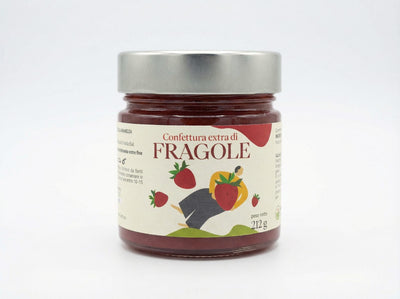
 | From our selection Strawberry JamHandmade, no preservatives. € 7,90 Discover → |
This article is a map of the main strawberry varieties grown in Italy today. It is not an exhaustive botanical classification, but a practical guide for anyone standing at a market stall, staring at a punnet, wondering what they are about to buy—and why certain varieties work better than others once they land in a jar of confettura.
A botanical note: what a strawberry actually is
Before diving into varieties, let’s clear up a small misunderstanding: botanically, a strawberry is not a actual fruit. It is a false fruit: the juicy, fragrant red part we eat is the flower’s receptacle, while the true fruits are the tiny yellow dots on the surface—the achenes, each containing a seed.
All cultivated strawberries belong to the genus Fragaria. The two main species are Fragaria vesca, the European woodland berry, and Fragaria × ananassa, an hybrid obtained in the early 1700s by crossing two American species. Almost every commercial variety derives from F. × ananassa; Nemi strawberries and true wild berries are F. vesca.
The big lowland cultivars: yield, size, travel
The “ordinary” supermarket strawberries mostly belong to a narrow group of international cultivars, bred over recent decades to withstand transport, keep their colour on the shelf and deliver high yields per hectare. Three names dominate.
Candonga
Candonga is probably the most widespread variety in intensive southern-Italian plantings, especially Basilicata, Puglia and Campania. Medium-large calibre, brilliant almost orange-red, sweet and juicy with a pleasantly crisp flesh. Classic season runs from late March to late May.
For confettura it is not the first choice: high water content, only moderate aroma, and it collapses faster than firmer-pulp types.
Sabrosa
Sabrosa (often sold as “Sabrosa Candonga”) is a Spanish cultivar that conquered southern Italy for its marked sweetness and generous size. Elongated heart shape, deep red, firm flesh. Harvest window is concentrated in April–May.
Alba
Alba is an Italian variety released in the 1990s, early ripening and prized by northern growers for productivity. Conical shape, medium size, balanced flavour.
Traditional Italian varieties: lower yield, higher identity
Beside industrial cultivars, Italy hosts several traditional strawberries, often at risk of disappearing, recovered over the past twenty years by small growers, Slow Food Presidia and regional agronomic centres. They are less productive, more delicate, costlier—and their aromatic profile is unforgettable.
Fragola di Tortona (Profumata di Tortona)
The Fragola di Tortona, a Slow Food Presidium, is a traditional Piedmontese variety grown around Tortona, Alessandria province. Small to medium, elongated, dark-red fruits with an intense perfume that earned the dialect nickname “fraga prufümada”.
Its season is short, late May to mid-June. It nearly vanished in the 1980-90s, ousted by higher-yielding cultivars, and is now safeguarded by a small growers’ presidium.
Fragoline di Nemi
Fragoline di Nemi, cultivated on the volcanic hills around Lake Nemi in the Castelli Romani, are Fragaria vesca. Tiny (1–2 cm), dark-red berries with heady scent and concentrated, slightly tart flavour. Nemi’s historic Strawberry Festival is held every June.
Fragoline di bosco
True woodland berries grow wild from the Alps to the Apennines and the Sila and Pollino hills. Intense perfume, concentrated flavour, fragile flesh.
Fragola di Romagna (cultivars Idea, Asia, Romina)
Romagna’s strawberry chain, developed since the 1970s, has selected specific varieties for northern Italy’s climate: Idea, Asia, Romina are the most common. More balanced aroma than southern types, medium calibre, firm flesh.
Which varieties suit confettura best
From an artisanal kitchen’s viewpoint, an ideal “jam” strawberry needs four traits:
- Intense, heat-stable aroma: if the scent volatilises at 70 °C the jar will fall flat.
- Present yet balanced acidity: acidity brings freshness and balances sugar.
- Firm flesh: very soft fruit turns to purée during preliminary handling.
- Adequate natural pectin: a splash of lemon juice or a touch of apple pectin is enough to set the right consistency.
How Cilento makes its “jam” strawberry
In Cilento, where strawberries grow on small plain and hillside plots, traditional practice favours short-cycle crops, fruit picked fully ripe and processed within 24–48 hours.
The strawberries that reach the Minnelea kitchen are never frozen, never puréed, never from concentrate. They are hulled, halved only if oversized, and cooked within hours. This short chain is what lets the berry’s perfume survive into the jar: in our strawberry confettura the aroma you smell when you twist off the lid is exactly the fruit’s own.
Seasonality: when to wait for real Italian strawberries
Open-field Italian strawberries run from late March (early cultivars under tunnels in the south) to late June (late northern cultivars and woodland berries). A minor autumn “re-flowering” (September–October) exists, but sizes are smaller and quality lower.
The December-January berries on Italian shelves largely come from Spain, Morocco, Egypt—cultivars bred for the road. A respectable confettura is made at peak harvest, with local fruit.
FAQ
Which is Italy’s most fragrant strawberry?
Among cultivated types, Fragola di Tortona is deemed the most aromatic. Among wild berries, Italian woodland berries are peerless.
Are Nemi strawberries the same as woodland berries?
Botanically they belong to the same species (Fragaria vesca), but Nemi berries are cultivated on dedicated plots in the Castelli Romani.
Why do some strawberries taste of nothing?
Usually a mix of three factors: cultivar bred for yield and transport, early harvest, long lag between picking and eating.
Are greenhouse berries lower quality?
Not necessarily. Variety choice, vine-ripening and a short chain matter more than the growing system itself.
What does “re-flowering” strawberry mean?
One that crops in several waves through the year instead of a single spring flush.
Knowing the varieties is the first step to choosing well. If you want to taste a confettura made from short-chain, never-frozen fruit, cooked slowly, start with Minnelea’s strawberry confettura.