
Sun-Dried Tomatoes: The Story of a Mediterranean Preserve from Pompeii to Today
Sun-dried tomatoes are one of the most Mediterranean ingredients you can find, yet they are also one of the newest in Italian culinary history. The tomato only reached Europe in the sixteenth century, after the discovery of the Americas, and for almost three centuries it was treated as an ornamental plant—or even as poisonous. The practice of drying it in the sun to preserve it is even more recent: it took hold in southern Italy between the nineteenth and early twentieth centuries, a practical answer to the problem of storing an abundant summer harvest.
 | From our selection Sun-dried Tomatoes in OilHandmade, no preservatives. € 7,90 Discover → |
This article traces the story of Italian sun-dried tomatoes: how the technique was born, why it rooted itself in the south, what changes between traditional and modern industrial drying, and why a new generation of small workshops is now bringing back jars that truly speak of tradition.
The tomato arrives late in Europe
The tomato (Solanum lycopersicum) is native to the Peruvian Andes and was cultivated by the Aztecs under the name tomatl. It reached Europe after 1500 aboard Spanish ships, but throughout the sixteenth and much of the seventeenth century it remained a garden plant, suspected of being toxic because it belongs to the Solanaceae family—the same as belladonna and mandrake.
The first to cook with it were peasants in southern Italy, especially in Campania and Sicily, where the hot, dry climate let it flourish. The earliest documented culinary reference in Italy appears in a 1692 Neapolitan recipe collection that already mentions a Spanish-style “tomato sauce.”
From there, the tomato slowly entered Italian cuisine, first as an occasional seasoning, then as a structural ingredient of pasta, pizza, and sauces. But the real revolution came in the nineteenth century, when people began to preserve it seriously for the winter months.
Sun-drying: an ancient technique applied to a new fruit
Sun-drying fruit and vegetables is as old as Mediterranean agriculture itself. Figs, grapes, tomatoes, peppers, eggplants—whatever ripened in summer was saved for winter with the heat of the sun, the air, and sometimes a pinch of salt.
When the tomato entered the southern-Italian pantry, drying became one of the most widespread natural preservation methods. The logic was pragmatic: at summer’s end tomatoes ripened in abundance, winter was coming, they had to last. Cut in half, lightly salted, laid on wooden racks or flat surfaces exposed to the sun, left for days to lose water. It was simple work but it demanded care: rain spoiled them, too much sun made them leathery, too little salt and they molded.
Once ready, the dried tomatoes were stored in glass or terracotta jars, sometimes under a veil of extra-virdgin olive oil, sometimes dry. They served all winter: to dress pasta, to enrich legume soups, as an antipasto with bread and oil, as a side to winter meats.
The Cilento tradition: tomatoes, sun and racks
In Cilento the tradition of sun-dried tomatoes is ancient and widespread. The territory offers ideal conditions: long, dry summers, intense sun, small-scale farming, a home-preservation culture passed through generations.
The classic Cilento method is simple: tomatoes are picked fully ripe, halved, lightly salted if desired, spread on wooden racks (the “cannizzi”) in a sunny spot. They are turned by hand once or twice a day for even drying. Under optimal conditions it takes five to ten days to obtain a completely dried tomato that has lost about 90 % of its original weight and is concentrated in sugars, minerals, and aroma.
Traditional Cilento sun-dried tomatoes have three distinctive traits: deep-red colour, a concentrated scent that recalls a tomato at peak season, and a soft yet not gummy texture. Once ready, they are preserved in extra-virgin olive oil—often from the same farm—perhaps with a few aromatics: capers, garlic, a bay leaf, a pinch of salt.
What changes with industrial drying
Modern canning industry, born in the 1950s-60s, transformed even the sun-dried tomato. Industrial production follows different rules from home preservation.
Standard industrial drying uses hot-air tunnels: tomatoes travel through a 60-80 °C airstream for 8-24 hours, losing water in a controlled, predictable way. The process is far faster (one day versus 5-10 under the sun), repeatable, weather-independent, but it has three technical consequences.
First: loss of aroma. The volatile aromatic molecules of a ripe tomato (esters, terpenes) disperse more quickly under artificial heat than under the sun. Industrially dried tomatoes have a flatter, more “neutral” aromatic profile.
Second: colour shift. High temperatures accelerate lycopene degradation (the tomato’s red pigment) and push the hue toward brown-orange. To compensate, industry may use additives.
Third: excessive uniformity. Sun-dried tomatoes vary from half to half, some softer, others drier. Industrial ones are all identical—an advantage for commerce but a loss of character.
Pomodori sott’olio: how a good preserve is made
Once dried, tomatoes must be stored. The classic form is under extra-virgin olive oil. A well-made preserve follows a few rules.
Short ingredient list. Sun-dried tomatoes, extra-virgin olive oil, perhaps capers, garlic, salt, aromatics (bay, oregano). Stop. No preservatives, no acidifiers, no industrial flavours.
Whole or half tomatoes, not crushed. The structure of the dried tomato should be respected: in quality jars you find recognisable tomatoes, not purée.
Covering oil. The oil is not just a preservative; it is part of the recipe. It keeps the tomatoes soft, guards their aroma, and once the jar is finished becomes a precious dressing for pasta, bruschetta, salads.
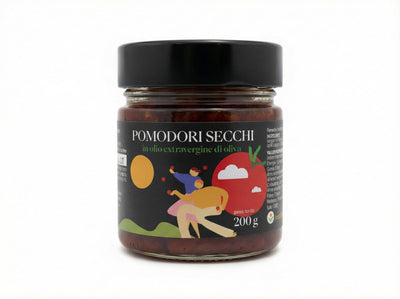
Our sun-dried tomatoes in EVO follow exactly this logic: tomatoes dried on wooden racks under the sun, preserved in extra-virgin olive oil with capers, garlic and a pinch of salt. Five ingredients, nothing else.
How to use sun-dried tomatoes in oil
Sun-dried tomatoes in oil are one of the most versatile staples of the Mediterranean pantry. Four main uses.
Antipasto. On a board alongside cured meats, aged cheeses, olives, taralli. Serve at room temperature with a few capers from the jar.
Pasta dressing. Cut into strips, warmed in a pan with some of their oil for two minutes, then tossed with pasta. They work alone or with black olives, capers, parsley.
Topping for bruschetta and focaccia. On toasted farmhouse bread with a thread of extra-virgin oil and a grind of pepper.
Side to grilled meats. A handful beside a chicken breast or steak gives freshness and contrast.
FAQ
Are sun-dried tomatoes Italian?
TheThe drying technique is especially common in southern Italy, but it also exists in Spain, Greece, Turkey, and southern France. Every Mediterranean country has its own version with small variations.
Can you eat sun-dried tomatoes without rehydrating them?
Tomatoes in oil are already “rehydrated” by the preserving oil: eat them straight. Dry-packed tomatoes must be rehydrated in warm water or vinegar before use.
What is the difference between semi-dry and fully dry?
“Semi-dry” tomatoes lose only part of their water and stay softer and juicier (often refrigerated). “Fully dry” tomatoes lose almost all water and keep at room temperature, usually under oil.
Can I make sun-dried tomatoes at home?
Yes, in theory—under the sun or in a home dehydrator. But quality results require very ripe tomatoes, favourable weather, and careful control. For many, buying a well-made artisan jar is easier.
Can I use the oil from the jar?
Yes, in fact it’s one of the product’s bonuses. The oil becomes flavoured with the tomatoes, aromatics and garlic, turning into an excellent dressing for pasta, bruschetta, salads.
If you want to taste a sun-dried tomato made the way it has always been made in Cilento, start with our sun-dried tomatoes in EVO: dried on racks under the sun, preserved in extra-virgin olive oil with capers and garlic. Five ingredients, nothing else.