
Sun-drying vs industrial drying: how the flavour of sun-dried tomatoes changes
“Sun-dried” is one of the most common phrases on Italian sun-dried-tomato labels. It evokes tradition, slowness, hand-craft. Yet market reality is more complex: the vast majority of dried tomatoes on sale are dehydrated in industrial hot-air tunnels, even when the label does not openly say so.
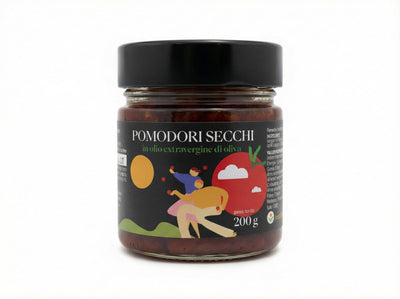
 | From our selection Sun-dried Tomatoes in OilHandmade, no preservatives. € 7,90 Discover → |
It’s worth understanding the difference, because between a tomato dried on a wooden rack under the sun and one dried in a high-output industrial tunnel, the gap is not a detail: three big things change—colour, aroma, texture. And you can taste them in the kitchen.
The two methods, face to face
Drying a tomato is a physico-chemical process whose goal is to remove most of water inside the fresh fruit (about 90-95 % of its original weight), thereby concentrating sugars, salts and perfumes. This can be done in two basically different ways.
Traditional sun drying. Tomatoes are halved, lightly salted if desired, and laid on wooden racks (the Cilento “cannizzi”, the Apulian “tavole”) or flat surfaces exposed to the sun. They are hand-turned once or twice a day to ensure even drying. The process typically lasts 5-10 days in midsummer, depending on climate, ambient humidity and tomato size. The temperature the tomatoes reach is simply that of the sun: 30-50 °C on the surface, rarely more.
Industrial tunnel drying. Tomatoes are loaded on conveyor belts and sent through drying tunnels blasted with hot air, usually 60-80 °C, for 8-24 h. The process is continuous, controlled, independent of weather and season. One industrial line can dry several tonnes a day, against the few dozen kilos of a small artisan.
What happens to the colour
The red of a tomato is due mainly to lycopene, a carotenoid from the pigment family that develops in the fruit as it ripens. Lycopene is heat-labile: it degrades when exposed to high temperatures for long periods, and its breakdown produces brown-orange compounds.
Sun drying, working at natural temperatures (30-50 °C on the surface), preserves the bulk of lycopene. A sun-dried tomato shows an intense, slightly uneven, vivid red. Industrial hot-air drying, operating at 60-80 °C, accelerates lycopene degradation. The industrially dried tomato drifts toward a browner, duller red, sometimes even standardised with added colour.
It’s a difference you can see with the naked eye: put two different jars side by side and notice the shade.
What happens to the aroma
A ripe tomato’s perfume comes from a blend of hundreds of volatile compounds—esters, alcohols, aldehydes, terpenes—formed in the final days on the plant. Key players: hexanal (grassy note), cis-3-hexenal (green note), various 2-methyl-butyrate esters (sweet-fruity notes).
These compounds are, by definition, volatile: they escape into the air, and the rate of loss rises exponentially with temperature. The higher the drying temperature, the faster the aromas vanish.
Sun drying, slow and cool, keeps a significant share of these native perfumes. A sun-dried tomato, once re-hydrated (say, by the extra-virgin oil in the jar), gives back in the mouth the true scent of an end-of-summer tomato.
Industrial hot-air drying, fast and hotter, “strips” most of these aromatics away in the first minutes. The industrially dried tomato has a flatter, more “neutral” aromatic profile. To compensate, some producers add natural or artificial flavours at the end.
What happens to the texture
Texture changes too. Sun drying is gradual: water evaporates slowly, the tomato’s cells collapse evenly, keeping a soft structure. A sun-dried tomato, once bottled in oil, is tender to the bite, slightly meaty, still recognisable as the original fruit.
Industrial drying is more aggressive: water is pulled out quickly, cells dehydrate unevenly, and the final product can feel rubbery, “hard”, less pleasant to chew. To offset this, some industrial lots are given partial re-hydration baths before packing.
A practical consequence: sun-dried tomatoes absorb the covering extra-virgin oil better, and the finished product has a more balanced mouthfeel.
The numbers at a glance
To give a concrete scale, here is a schematic comparison of the two methods:
| Parameter | Sun drying | Industrial drying |
|---|---|---|
| Temperature | 30-50 °C | 60-80 °C |
| Time | 5-10 days | 8-24 h |
| Energy per kg | Almost zero (sun) | Significant (diesel or gas) |
| Labour cost | High (racks, hand-turning) | Low (automated process) |
| Lycopene retention | 70-90 % | 40-60 % |
| Volatile aroma retention | 50-70 % | 20-40 % |
| Product uniformity | Variable | Very high |
| Added colours | Never (artisanal) | Sometimes |
| Added flavours | Never (artisan:) | Sometimes | \n
| Daily throughput | Tens of kg | Tonnes |
The price of tradition
Sun-drying costs more. Three reasons.
Labour time. Racks must be set, tomatoes cut and laid one by one, turned daily, shielded from sudden rain. It is physical, intensive work that depends on people.
Space. You need exposed surfaces: terraces, courtyards flat roofs. Space is a resource, especially for anything above tiny volumes.
Seasonality. You can sun-dry only in summer, and production is squeezed into a few weeks. The rest of the year the workshop handles already-dried stock. Cash flow is less regular than in year-round production.
The outcome is a significantly higher cost per kilo than for industrially dried tomatoes. It is why a well-made artisan jar cannot cost the same as an industrial one.
The Minnelea example
In our own production, the sun-dried tomatoes in EVO are dried on wooden racks under the sun, exactly as it has always been done in the homes of Cilento. No ovens, no fans, no hot-air tunnels. Just the sun, slow and patient, concentrating the sweetness and coaxing out the aroma day after day.
Once ready, the tomatoes are left whole and rested in extra-virgin olive oil, with a few capers, a sliver of garlic and a pinch of salt. Nothing else. No preservatives, no colourants, no flavour enhancers. Five ingredients, all declared on the label.
FAQ
How can I tell if a sun-dried tomato was really sun-dried or tunnel-dried?
Visually: a vivid, slightly uneven red is a good sign of sun drying. For certainty, read the label—serious artisan producers state “sun-d dried”.
Are industrially dried tomatoes bad?
Not necessarily: they are simply different. They have a flatter, less characterful profile, but they are usable in the kitchen. The gap shows when you eat them as they are (on a board, for instance); less so when they are an ingredient in a complex dish.
Is sun drying hygienic?
Yes, provided good practice is followed: clean racks, size sorting, light salting to curb initial microbial growth, airy location. Artisan producers with HACCP certification follow strict protocols.
Can you sun-dry in northern Italy too?
Hardly. Sun drying needs high temperatures, low humidity, intense prolonged sun. Southern regions (Campania, Puglia, Sicily, Calabria) have historically been the most suitable. In the north, cabinet or low-temperature-oven drying is more common.
What does “semi-dried” mean?
These are tomatoes that lose only part of their water (about 50-70 %) and stay softer and juicier. They must be kept refrigerated and have a shorter shelf life. They are not “sun-dried tomatoes” in the classic sense.
If you want to taste the difference between a sun-dried and an industrially dried tomato, start with our Cilento sun-dried tomatoes in oil: dried on wooden racks under the sun, preserved in extra-virgin olive oil.