
Replacing supermarket jam: 4 practical reasons
A supermarket jam at €2 and an artisan jam at €9 look like two products on the same shelf. In reality, they are two different things, made differently, with different nutritional profiles.
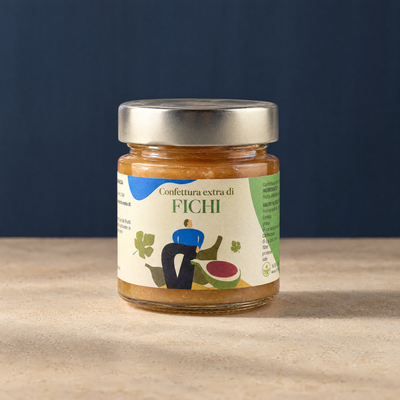
 | From our selection Fig JamHandmade, no preservatives. € 7,90 Discover → |
This is not a crusade: industrial jam makes sense when you want something predictable, affordable and ready to go. But if you eat bread and jam 200 days a year, it is worth thinking about.
Here are the 4 concrete reasons why switching to artisan makes sense.
Reason 1 — How much fruit is actually inside
EU Directive 2001/113 sets the minimum threshold at 35 g of fruit per 100 g of jam (45 g for "extra" jam). Standard industrial jams tend to sit very close to this minimum: 35–45 g.
A quality artisan jam regularly reaches 60–75 g of fruit per 100 g. That is nearly twice as much.
What difference does it make in practice? Spreadability, colour, persistence on the palate. A 70% fruit jam is almost a sweetened fruit purée, not a gelled syrup.

Reason 2 — Not all sugar is the same
Industrial jams often use glucose-fructose syrup or large amounts of refined sucrose. Glucose-fructose syrup is a low-cost, high-preservation-yield sugar, but with a faster absorption profile than sucrose (associated with sharper blood sugar swings, as documented in general nutritional literature).
A well-made artisan jam uses only sugar or cane sugar, in smaller quantities because it compensates with more fruit. Often without added pectin, because the natural pectin in lemon is sufficient.
For an average breakfast serving (20 g of product on bread):
- Industrial jam (60% total sugars): ~12 g of sugars
- Artisan jam (45% total sugars): ~9 g of sugars
Over 200 breakfasts a year that is approximately 600 g less sugar per year. Not dramatic numbers, but real ones.
Reason 3 — Preservatives, additives, colourants
An industrial jam may contain:
- Added pectin (E440)
- Citric acid (E330)
- Sorbates/benzoates (E200–E219)
- Colourants (E120, E163) to standardise colour from season to season
All these additives are permitted and considered safe at authorised doses. But they are also superfluous if the product is made with the right fruit in the right quantities and cooked correctly.
A typical artisan jam has 3–4 ingredients: fruit, sugar, lemon juice, (sometimes) a natural vegetable gelling agent. That is it.
Reason 4 — The real cost per gram of fruit
This is the figure that turns the "artisan = expensive" perception on its head.
Calculation:
- Industrial jam: €3/350 g at 35% fruit = €24.50/kg of actual fruit
- Artisan jam: €9/350 g at 70% fruit = €36.70/kg of actual fruit
The real difference is approximately €12/kg of fruit. But consider that with a denser jam you also use less at breakfast (one artisan teaspoon goes as far as two industrial ones). When you account for equal fruit consumption, the price premium halves.
What to check on the label in 10 seconds
- % fruit: below 45% — leave it
- Ingredients: max 4–5 good ones; long lists of E-numbers are suspicious
- Type of sugar: just "sugar" or "cane sugar" is better than "glucose-fructose syrup"
- Fruit origin: specifically stated or generic?
- Preservatives: look for "no preservatives" or the absence of E200–E219 in the list
When industrial jam still makes sense
Honestly, in some cases yes:
- Baking: for tarts, filled biscuits and glazes, standard jam works fine because oven heat erases the flavour differences anyway
- Tight budget: if the weekly shop is the main constraint, inexpensive jam is not a dietary crime
- Fussy children: industrial jam has more "neutral" and standardised flavours; some children are wary of artisan jams with visible fruit pieces
How to start switching (without the drama)
No need to change everything at once. A 3-step strategy:
- Just one artisan jam in the house, alongside your usual one. For two weeks try alternating them day by day
- A blind comparison: same slice of bread, same type of bread, one jam for a week and the other the next. Taste the difference
- If the switch convinces you, gradually replace. If it does not, keep the industrial one for daily use and the artisan one for special occasions
Frequently asked questions
Is artisan jam actually healthier?
"Healthier" is a regulated term under EU Regulation 1924/2006 on nutritional and health claims. What can be stated accurately: it has more fruit, fewer added sugars and fewer additives. The final nutritional balance always depends on the total quantity consumed.
Can I make my own jam at home to save money?
Yes, but care is needed: cooking temperature (at least 104 °C at the core for correct preservation), sterilised jars, and real shelf life (at home you will rarely reach the 18–24 months of commercial products). And the time involved has a value.
Are all supermarket jams industrial?
No. Some premium supermarkets stock artisan lines from small producers, identifiable by their detailed label. But these are a minority on the shelf.
Are organic and artisan the same thing?
No. "Organic" certifies the farming of the raw material, not the transformation process. There are organic jams produced industrially, with additives permitted under organic standards.
How long do artisan jams last once opened?
3–4 weeks in the fridge in a sealed container with clean utensils. Slightly less than preservative-rich industrial jams, but sufficient for regular breakfast consumption.
Sources
EU Directive 2001/113 on extra jams, jams, jellies and marmalades
EU Regulation 1924/2006 on nutritional and health claims
CREA — Food composition tables
Further reading
Difference between jam, confiture and compote
How to choose an artisan jam
Minnelea artisan jams — just fruit, sugar and lemon juice. No preservatives, no colourants, no syrups.