
Storing Tomatoes in Oil: Shelf Life, Temperature, and Signs of Spoilage
Sott’oli are among the most loved preserves, but also the most delicate to handle. A properly made jar of sun-dried tomatoes in EVO oil can last up to two years while sealed, yet once opened it demands care: the oil, salt and gentle acidity of the tomato create a protective environment, but not a sterile one like a confettura. It pays to know how to treat it.
 | From our selection Fig JamHandmade, no preservatives. € 7,90 Discover → |
This article is a practical, no-nonsense guide to storing tomatoes in oil: how long they really last, where to keep them, what to do once the jar is opened, and how to spot a product that has turned. And an important chapter: the risk of botulism and why it must be taken seriously in sott’oli, even though it is extremely rare in certified artisan products.
Why sott’oli are “delicate” compared with confetture
A confettura has three powerful natural bodyguards: high sugar (60–65%), low water activity, and an acid pH (3.0–3.5). Together they make microbial growth almost impossible.
Tomatoes in oil live a different life: little sugar, higher water activity (sun-dried tomatoes re-absorb some oil but keep inner moisture), and a less acidic pH than you might think. Protection comes mainly from three factors: air exclusion (the oil forms a physical barrier between food and oxygen), salt (present in small amounts, it lowers water activity), and initial heat treatment (drying and sometimes jar pasteurisation).
This set-up keeps mould and yeast at bay, but it has a weak spot against one particular microbe: Clostridium botulinum.
The botulism risk: serious but manageable
Clostridium botulinum is an anaerobic bacterium (it grows only without oxygen) that produces an extremely potent neurotoxin responsible for food-borne botulism. It is a real threat for sott’oli, especially home-made ones without proper acidification.
The bug thrives where there is: no oxygen (perfect under oil), pH above 4.6, high-enough water activity, and temperatures between 4 °C and 50 °C. Vegetable preserves in oil (tomatoes, aubergines, peppers, mushrooms) are exactly the stage where it can perform if the other parameters are not kept in check.
Certified artisan producers manage the risk in three ways: acidification (vinegar or citric acid to push pH below 4.6), heat treatment (jar pasteurisation to inactivate spores), water-activity control (pre-drying the tomatoes slashes free moisture).
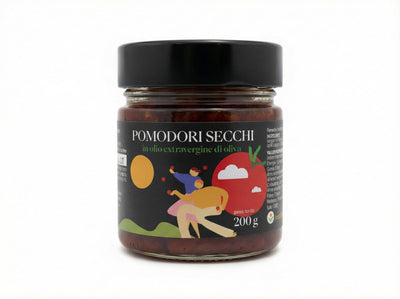
Our sun-dried tomatoes in EVO oil are produced following all three: tomatoes well dried in the sun, light salting, a controlled jarring process. In a certified artisan product the botulism risk is essentially absent.
Home-made preserves are a different story: follow the Italian National Health Institute guidelines and stick to rigorous protocols.
The sealed jar: how long it really lasts
A properly filled, soundly sealed jar of sun-dried tomatoes in EVO oil carries a label shelf life that typically runs from 12 to 24 months from production.
The product ages faster than a confettura: extra-virgin olive oil exposed to light and heat can oxidise and give the contents a rancid, unpleasant edge.
- 0–6 months: product at its peak. Tomatoes are supple, aroma intense, oil bright.
- 6–12 months: still excellent quality.
- 12–24 months: oil may develop faint oxidative notes. Tomato remains safe but the aromatic profile fades.
- Beyond 24 months: oil can become noticeably “tired”. Not necessarily dangerous, but flavour is compromised.
Where to store the sealed jar
Away from heat sources. Not above the oven, not near the fridge motor, not in summer kitchens that climb past 25 °C. Heat speeds EVO oxidation.
Out of the light. Direct sun is EVO’s worst enemy: it turns it rancid fast. Keep jars in closed cupboards if your kitchen is bright.
In a dry place. Humidity will not hurt the contents (the jar is airtight) but can rust the metal cap.
The sweet spot: an indoor pantry, 12–22 °C, dry and dark. A normal kitchen cabinet is perfect.
Opening the jar: the critical moment
Opening changes everything. Oxygen meets the food, microbes can ride in on spoons or fingers, the oil oxidises faster.
In the fridge (about 4 °C): 1 month. This is the standard reference for artisan sun-dried tomatoes in oil. It is longer than opened confetture (2–3 weeks) because the oil gives mechanical cover and the environment is less welcoming to mould and yeast, but shorter than other preserves because the tomatoes gradually re-hydrate and the oil oxidises.
Industrial products with added preservatives may quote a longer post-opening life. Well-made artisan products, free of preservatives, should be eaten within the indicative month.
Practical rules for the opened jar
Keep the tomatoes submerged. If they peek above the oil after you have spooned some out, push them back under or top up with fresh EVO until covered. Tomato exposed to air is the first to mould.
Return to the fridge immediately after use. Even a few hours at summer room temperature is best avoided.
Use only clean utensils. Forks or spoons that have been elsewhere import microbes.
Never add water or fresh ingredients. Any extra moisture or new organic matter raises the risk.
Do not leave the jar open on the table for hours. Even during a long lunch, close it and bring it out only when needed.
How to spot a sott’olio that has turned
Bulged lid or odd “click”. A dome-shaped metal lid signals gas production inside. Discard immediately, unopened.
Bubbles or foam on opening. Signs of active fermentation. Do not eat.
Off smell. Whiffs of alcohol, solvent, strong rancidity, or rot. Normal aroma is concentrated ripe tomato, EVO, and any added aromatics (capers, garlic).
Surface mould. Green, white or black spots. Throw the whole jar away; scraping off visible mould is not enough.
Heavily cloudy oil. Slight clouding in the fridge is normal (some fatty acids solidify at low temperature). Pronounced clouding at room temperature together with off smells is a red flag.
What is NOT a worry
Oil solidifies in the fridge. Normal: EVO contains fatty acids that crystallise below 7–8 °C. It liquefies again at room temperature and is even a quality cue (high-unsaturated oils crystallise).
Slight darkening of top tomatoes. The air-exposed layer may darken a little through oxidation. If there is no mould or strange smell, push them back under the oil and carry on.
Salt crystals on the bottom. Normal. They dissolve with a gentle swirl.
Crystals on the glass. Can be salt or fatty-acid crystals. Harmless.
FAQ
Can I store opened tomatoes in oil outside the fridge?
No. The fridge is mandatory after opening to lower microbial risk and slow oil oxidation.
Can I use the oil once the tomatoes are finished?
Yes, the flavoured oil is precious. Finish it within a few days of the last tomato.
Can I transfer the tomatoes to a smaller jar?
Yes, as long as the new jar is perfectly clean and the tomatoes stay completely covered by oil.
Can I freeze tomatoes in oil?
Technically yes, but freezing changes the texture (tomatoes become softer). Skip it for table use; acceptable if you plan to cook them.
How real is the botulism risk in an industrial or certified artisan jar?
Extremely low. Commercial products follow strict food-safety protocols. Real risk is almost exclusively linked to home preserves without proper acidification.
Opened the jar and treating it right? Good. Next time start with our Cilento sun-dried tomatoes in EVO oil: dried under the sun, preserved in extra-virgin oil, with a HACCP process that guarantees both safety and fragrance.