
San Marzano Tomato Sauce: Authentic and Simple to Prepare
With genuine San Marzano DOP tinned tomatoes, you can create a tomato sauce at home that tastes of Southern Italy: naturally sweet, barely acidic, with a flesh that almost transforms into silk as it simmers. Those with thirty minutes will achieve a vibrant, bright sauce. Those who bring time and patience will, through slow reduction, attain a depth that recalls a Sunday lunch in Campania. Both paths begin with the same foundation: the Pomodoro San Marzano dell'Agro Sarnese-Nocerino DOP, the only tomato with legally protected designation of origin for this purpose. Minnelea, as an artisan brand from Cilento, works with precisely this quality and shows here how best to prepare it at home.
Table of Contents
- What do you need for a genuine San Marzano tomato sauce?
- How do you make the quick 30-minute sauce?
- How do you cook the traditional long-simmer sauce?
- What to do if the sauce is too acidic, bitter, or watery?
- How long does the sauce keep and how do you freeze it?
- What does the sauce pair with and how do you use it?
- What variations and alternatives are there?
- Where can you buy genuine DOP tomatoes in Germany?
- Why does DOP provenance make the difference?
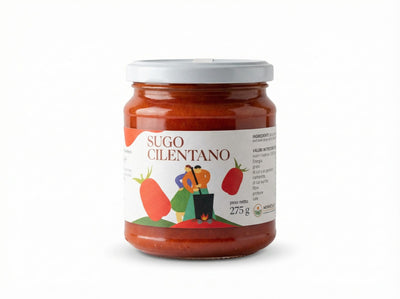
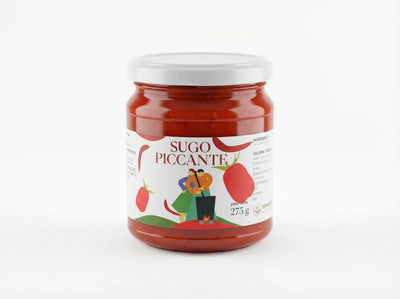
- Artisan tomato sauce from Minnelea: for those who don't want to lose time
What do you need for a genuine San Marzano tomato sauce?
Ingredients for 4 servings
- whole peeled San Marzano tomatoes from a tin (DOP-certified)
- 3 tbsp extra virgin olive oil
- 2–3 garlic cloves, lightly crushed or finely chopped
- 1 medium onion, finely diced
- 1 tbsp tomato paste (optional, for more depth)
- 1 tsp fine sea salt, to taste
- 4–5 fresh basil leaves (add only at the end)
- 1 piece of Parmigiano-Reggiano rind (optional, for umami)
- 1 pinch sugar (only if needed, if the sauce seems too acidic)
Fresh San Marzano tomatoes are scarcely found in Germany outside the season. Those who do find them, perhaps at a weekly market with Italian specialities, may use them; but expect somewhat more water content and a longer simmering time.
Tinned tomatoes compared
| Tomato variety | Texture | Sweetness | Seed content | Water content |
|---|---|---|---|---|
| San Marzano DOP (tinned) | Firm, creamy | High | Low | Low |
| Fresh San Marzano | Firm, aromatic | Very high | Low | Medium |
| Roma / plum tomatoes | Firm core | Medium | Medium | Medium |
| Standard tinned tomatoes | Soft, watery | Low | High | High |
Genuine DOP tins almost always contain whole, peeled tomatoes without additives. Chopped varieties or sauces with seasonings generally do not carry the DOP seal.
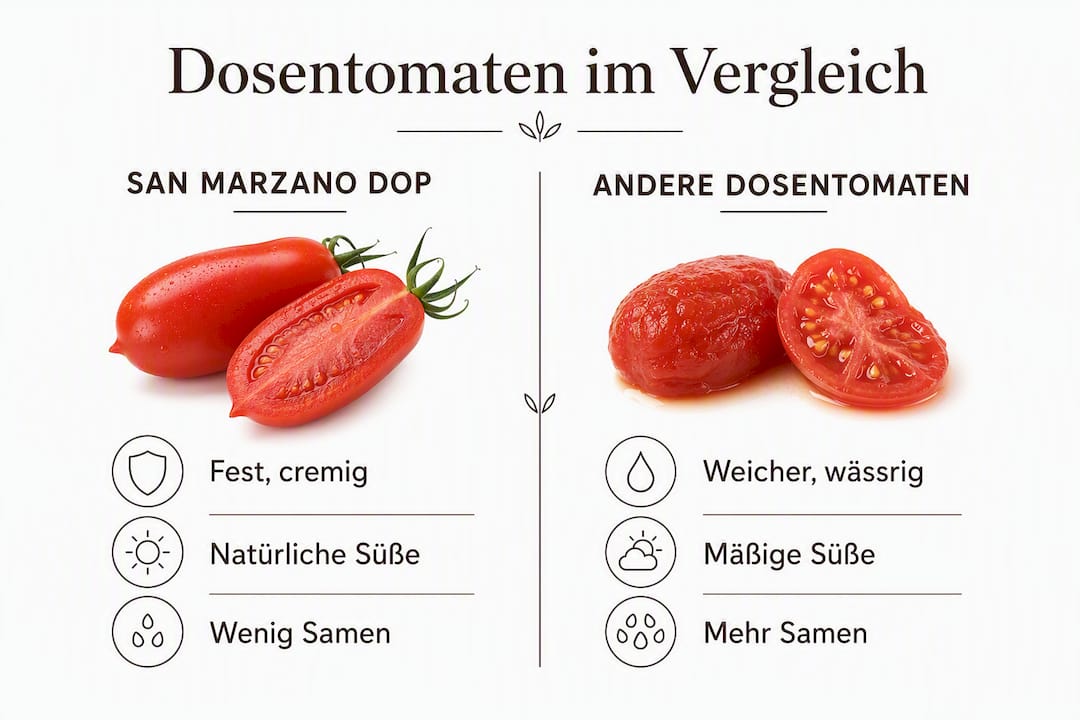
Pro tip: You'll find the DOP seal on the tin as the complete designation "Pomodoro San Marzano dell'Agro Sarnese-Nocerino DOP" as well as a coloured EU circular seal. If it only says "San Marzano style" or the origin reference to Campania is missing, it is not the original.
How do you make the quick 30-minute sauce?
Quick recipes with San Marzano show that just 30 minutes are enough to cook a sauce with far more character than any supermarket ready-made sauce. The secret lies in the quality of the tomato and a steady hand at the stove.
Step by step
- Heat the olive oil: Warm the oil in a wide pan or shallow pot over medium heat until it shimmers.
- Sweat the garlic: Add the garlic and let it turn translucent over low to medium heat, without browning.
- Add the onion: Stir in the diced onion and sweat until soft, until it becomes translucent and smells slightly sweet.
- Add the tomatoes: Roughly crush the tinned tomatoes, add to the pot, and stir in the tomato paste.
- Let it simmer: Reduce the heat and let the sauce simmer uncovered, stirring occasionally, until it has thickened and lost its raw note.
- Season and finish: Salt, and if needed a pinch of sugar. Stir in fresh basil only now. Those wanting a smoother texture can briefly purée with an immersion blender.
Texture to your liking
- Rustic and chunky: Only roughly crush the tomatoes, do not purée.
- Velvety and smooth: Use an immersion blender directly in the pot, or pass the sauce through a fine sieve.
- Middle way: Purée half, leave half chunky, and combine both.
Pro tip: At the end, pour a splash of the tin liquid into the empty tomato tin, swirl briefly, and add the liquid to the sauce. This way you use every last bit of flavour and naturally adjust the consistency.
Quick version at a glance: Preparation takes only a few minutes, cooking time is half an hour, and it yields enough sauce for several portions of pasta.
How do you cook the traditional long-simmer sauce?
Anyone who has tasted a sauce that stood on the stove for three hours understands why Italian families reserve a whole day for it. Slow simmering over several hours transforms the acidity of the tomato into sweetness, concentrates the flesh, and builds a depth that no quick version can achieve.
Step by step
- Slowly caramelise the onions (10–15 min): Warm the olive oil over low heat. Add the onions and let them soften very slowly, almost without colour. This step must not be skipped.
- Add the garlic (3–5 min): Only when the onions are soft, stir in the garlic. Sweat briefly.
- Toast the tomato paste (2 min): Add the tomato paste and briefly sweat while stirring. It darkens slightly and gives the sauce depth.
- Add the tomatoes and Parmesan rind: Stir in the crushed tinned tomatoes. Add the Parmigiano-Reggiano rind.
- First simmering phase (1.5 hours): Reduce heat to the lowest setting. Place the lid slightly ajar. Stir every 20–30 minutes. The sauce begins to thicken.
- Second simmering phase (another 1.5 hours): Remove the lid and let the sauce simmer uncovered. It reduces significantly, the colour deepening from light red to a rich dark red.
- Remove the Parmesan rind, season: Stir in salt and basil. Those who like can add a splash of high-quality olive oil as a finish.
Variations and refinements
- Rustic: Leave the sauce chunky, serve roughly crushed.
- Velvety: After cooking, purée finely with an immersion blender.
- Herbs: Oregano and thyme can be added earlier; fresh basil always only at the end.
Pro tip: Use a heavy, tall pot of cast iron or enamelled steel. It distributes heat more evenly and prevents burning at the bottom, which is the most common mistake with long cooking times.
| Cooking time | Result | Texture | Depth of flavour |
|---|---|---|---|
| 30 minutes | Fresh, vibrant | Medium | Good |
| 1.5 hours | Balanced, rounded | Thickish | Very good |
| 3 hours | Intense, complex | Dense | Excellent |
What to do if the sauce is too acidic, bitter, or watery?
Even with good ingredients, things can go wrong. The good news: most problems can be corrected at the stove.
- Bitter garlic notes: The garlic was too hot or in the oil too long. Stretch the sauce with a little more onion or a splash of water and continue simmering. Next time, add the garlic only after the onions and keep the heat low.
- Too acidic sauce: Reduce a little further, that often helps. Alternatively, stir in a small pinch of sugar, no more than half a teaspoon. Those who prefer no sugar can simmer a carrot along and remove it before serving.
- Too watery: Remove the lid and continue simmering uncovered. Those in a hurry can slightly increase the heat and stir more frequently.
- Too chunky: Use an immersion blender directly in the pot or pass through a sieve.
- Too smooth: Let simmer uncovered a little longer until the desired consistency is reached.
Pro tip: A finish with a tablespoon of good olive oil or freshly grated Pecorino Romano shortly before serving gives the sauce more body and elegantly rounds off acidity and bitterness.
How long does the sauce keep and how do you freeze it?
A well-cooked tomato sauce is a treasure that can easily be kept in reserve.
- In the refrigerator: In a clean, sealed glass container, the sauce keeps for several days. It is important to let it cool completely before placing it in the fridge.
- In the freezer: The sauce can be well preserved for months if packed airtight. Freezer bags and glass containers are suitable storage options.
- Portioning: 250 ml corresponds to one serving for two people as a pasta sauce. 500 ml suffices for a family meal. Freezing in portions saves time and prevents waste.
- Thawing: Best overnight in the refrigerator. Those in a hurry can place the bag in cold water.
- Reheating: In a pan over low heat with occasional stirring. Add fresh basil only after reheating.
Pro tip: Freeze the sauce in ice cube trays and place the frozen cubes in a freezer bag. This way you have small portions for soups, risotto, or as a base for braises, without having to thaw the whole batch.
What does the sauce pair with and how do you use it?
A good San Marzano tomato sauce is not an accompaniment. It is the heart of the dish.
- Pasta al Pomodoro: Toss spaghetti or penne in the sauce, fresh basil, a hint of olive oil. No cheese necessary, though Parmigiano-Reggiano never hurts.
- Pizza base: Spread the sauce cold onto the dough, thinly and evenly. Oregano instead of basil, as basil loses its character during baking.
- Meatballs (Polpette): Finish cooking the meatballs directly in the sauce so they absorb the flavour.
- Polenta: Pour the sauce over creamy polenta, sprinkle with Pecorino.
- Risotto aromatisation: Stir two to three tablespoons of sauce into the risotto towards the end of cooking for colour and depth.
- Shakshuka base: Poach eggs directly in the simmering sauce, serve with feta and fresh herbs.
| Use | Recommended herbs | Cheese pairing |
|---|---|---|
| Pasta | Fresh basil | Parmigiano-Reggiano |
| Pizza | Oregano | Mozzarella |
| Meatballs | Parsley, thyme | Pecorino Romano |
| Polenta | Sage | Pecorino Romano |
Those who want to know which tomatoes are best for pizza and sugo will find a practical guide at Minnelea.
What variations and alternatives are there?
DOP products are not always to hand. And sometimes the sauce should simply taste different.
- Spicy (Arrabbiata): Sweat peperoncino together with the garlic. Amount to taste.
- Creamy: Stir in a splash of cream or a knob of butter at the end. A creamy tomato cream sauce recipe serves as inspiration.
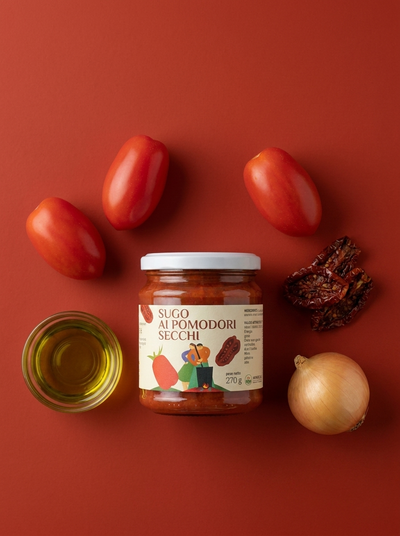
- With sun-dried tomatoes: Finely chop two to three sun-dried tomatoes and sweat with the onions. Adds intensity without more liquid.
- Tomato paste boost: Toast two tablespoons of tomato paste early on, for a darker, more robust sauce.
What to do when no DOP tomatoes are available?
| Substitute | Adjustment needed? | Result |
|---|---|---|
| Italian tinned tomatoes (without DOP) | Some sugar, reduce longer | Good, but less complex |
| Roma tomatoes (fresh) | Remove seeds, simmer longer | Fresher, less deep |
| Passata (strained tomatoes) | Shorten cooking time | Smooth, but flatter in aroma |
Pro tip: Always add fresh herbs like basil and parsley only at the end. Dried herbs like oregano or thyme can go into the pot earlier, as they need heat to develop their aroma. Rule of thumb: one teaspoon dried equals about one tablespoon fresh.
Where can you buy genuine DOP tomatoes in Germany?
In Germany, the offering of genuine DOP products is limited but present. Those who know where to look will find them.
Label checklist when buying
- Complete designation on the tin: "Pomodoro San Marzano dell'Agro Sarnese-Nocerino DOP"
- Coloured EU circular seal (red-yellow) on front or back
- Origin indication: Campania, Italy
- Ingredients list: only tomatoes, tomato juice, salt (no additives, no seasonings)
- Tin contents: whole, peeled tomatoes, not chopped
EU law protects the DOP designation bindingly: only tomatoes from the Agro Sarnese-Nocerino may bear this name.
Where to buy in Germany?
- Delicatessens and Italian speciality shops: DOP products are most reliably found here, often from smaller importers.
- Well-stocked supermarkets: Some branches carry DOP tins in their range, usually on the shelf with Italian specialities.
- Online shops: Search for "San Marzano DOP tomatoes" or "tomatoes from Campania". Read product descriptions carefully: Italian manufacturer, whole peeled tomatoes, DOP seal visible.
Pro tip: Beware of products that only say "San Marzano style" or "San Marzano type". This is not a quality mark but a marketing term without legal basis. Minnelea recommends always checking the product photo of the tin when buying online, not just the product description.
Why does DOP provenance make the difference?
The San Marzano tomato grows in a narrow strip of volcanic soil between Naples and Salerno, the Agro Sarnese-Nocerino. This soil, rich in minerals from Vesuvius, gives the tomato its characteristic structure: thicker fruit walls, fewer seeds, a natural sweetness that no cultivation outside this region can fully replicate. Those who want to learn more about the origin and characteristics of the San Marzano tomato will find a detailed background article at Minnelea.
The EU regulation on protected designation of origin protects consumers from imitations and secures fair conditions for producers. For Minnelea as an artisan brand from Cilento, this framework is not bureaucracy but foundation. Our products are made in small batches, with selected regional ingredients, and respect for provenance is not a slogan but practice.
- DOP stands for Denominazione di Origine Protetta, the EU protected designation of origin.
- Only tomatoes from the Agro Sarnese-Nocerino may be marketed as "Pomodoro San Marzano dell'Agro Sarnese-Nocerino DOP".
- Artisan processing in small batches preserves the aromatic diversity that industrial mass production often levels.
- Minnelea processes ingredients from Southern Italy with the same claim: no unnecessary additives, no compromise on provenance.
Key insights
Genuine San Marzano tomato sauce only succeeds with DOP-certified tomatoes from the Agro Sarnese-Nocerino, gentle heat, and fresh basil at the end.
| Topic | Details |
|---|---|
| Buy DOP | Only tins with "Pomodoro San Marzano dell'Agro Sarnese-Nocerino DOP" and EU circular seal are authentic. |
| Two methods | 30 minutes for a vibrant everyday sauce; 3 hours for a deep, complex family version. |
| Storage | Several days in the refrigerator, months in the freezer, frozen in portions. |
| Basil last | Always add fresh herbs only at the end so their aromas are preserved. |
| Minnelea as alternative | Those without time will find artisan ready-made products from Southern Italy at Minnelea with the same quality claim. |
What we have learned from years with San Marzano
The greatest misconception when cooking with San Marzano is that the tomato does all the work alone. That is not quite true. It forgives less than a robust Roma, because its aroma is finer and more delicate. Too high heat, garlic added too early, a lid left on too long: all of this costs flavour.
What we have learned: The sauce wants patience, not attention. Once set to low, it only needs occasional stirring. Those who constantly adjust, correct, and taste disturb the process more than they help.
And when is an artisan ready-made product worthwhile? When time is short, when you want to bring someone something special, or when you seek a reliable base for variations that you don't want to cook from scratch every time. Minnelea is made for exactly these moments.
Artisan tomato sauce from Minnelea: for those who don't want to lose time
Not every evening allows three hours at the stove. And not every week offers the leisure to seek out DOP tins, slowly caramelise onions, and reduce the sauce to the right consistency. For exactly these moments, Minnelea has developed its artisan products: in small batches, with selected ingredients from Southern Italy, without compromise on provenance and taste.


Minnelea delivers to Germany and is suitable as a base for pasta, pizza, and braises, but also as a gift for people who appreciate good food. Those curious about what artisan quality from Cilento specifically means can get a first impression with the antipasti in extra virgin olive oil. And those who want to know more about buying ready-made sauces will find a guide to recognising quality at Minnelea. Visit the online shop and find the product that suits your next dinner.
Further sources and reading tips
- A Simple Palate: San Marzano Tomato Sauce (family recipe) — Detailed family recipe with focus on slow simmering and Parmesan rind; practical for the long-simmer version.
Recommendation
- Preparing authentic tomato sauce: the guide – Azienda Agricola Minnelea
- Tomato sauce recipe: Italian original, 4 ingredients – Azienda Agricola Minnelea
- Cream sauce with tomatoes: creamy recipe in 20 minutes – Azienda Agricola Minnelea
- Simple tomato sauce: 3 ingredients, 15 minutes – Azienda Agricola Minnelea