
Sicilian Orange Marmalade: What Sets It Apart?
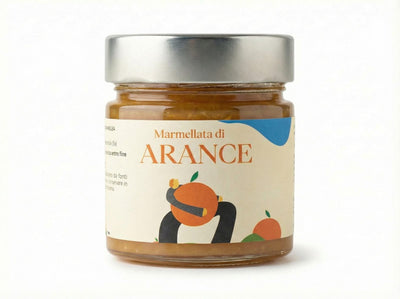
 | From our selection Orange MarmaladeHandmade, no preservatives. € 7,90 Discover → |
Anyone who has ever tasted Sicilian orange marmalade next to a classic British jar knows instantly: these are two entirely different worlds. The question “what makes Sicilian orange marmalade different?” sounds simple, yet it is packed with details that shape flavour, texture, and aroma. Sicilian marmalade captivates with an intense, fruity-aromatic profile and only the gentlest whisper of bitterness. This article reveals why, which ingredients and steps lie behind it, and how you can recognise—and savour—the difference yourself.
Table of Contents
- Key Takeaways
- Sicilian Orange Marmalade: the Basics
- Ingredients of Sicilian Orange Marmalade
- Craft: De-bittering & Cooking Time
- Sicilian vs. Other Marmalades
- Regional Variations from Sicily
- Enjoy & Make Your Own
- My Experience with Sicilian Marmalade
- Discover Authentic Marmalade from Minnelea
- FAQ
Key Takeaways
| Point | Details |
|---|---|
| Ingredients make the difference | Sicilian marmalade uses whole peel and pulp for a deeper orange aroma. |
| De-bittering is the key step | Repeated blanching reduces bitterness while preserving delicate orange notes. |
| Variety shapes flavour | Blood oranges such as Tarocco or Moro lend colour and fruit-forward character. |
| British vs. Sicilian | British marmalade is markedly bitter; Sicilian versions are aromatic and mellow. |
| Gelling affects texture | 2:1 jam sugar or fruit pectin determines sweetness and final consistency. |
Sicilian Orange Marmalade: the Basics
Orange marmalade is not just orange marmalade. The first time you open a true Sicilian jar, the scent tells the story: a warm, almost floral orange aroma rises, rounder and sweeter than the sharp citrus bite of many British classics. The difference lies deep in the recipe—in the choice of fruit and in the way the peel is treated.
Many people confuse orange marmalade in general with the British bitter-orange version, which is distinctly tart and herbaceous. Sicilian marmalade, however, balances bitterness and sweetness so that the orange aroma takes centre stage, not the sharpness of the peel. This is no accident; it is the result of deliberate choices in ingredients and processing.
Then there is the terroir: Sicily is one of Europe’s most fertile orange regions. Volcanic soil, a Mediterranean climate, and centuries-old cultivation traditions yield fruit that is inherently more aromatic and juicy than many other varieties.
Ingredients of Sicilian Orange Marmalade
What goes into the pot decides everything. Traditional Sicilian marmalade is made with whole peel and pulp, producing a far more intense orange flavour than recipes that rely solely on juice. The peel releases essential oils during cooking, giving the marmalade its characteristic depth.
The key ingredients at a glance:
- Whole orange peel with white albedo, de-bittered before cooking
- Pulp and juice for sweetness, acidity, and fruitiness
- Sugar or 2:1 jam sugar depending on desired sweetness and texture
- Fruit pectin as a natural gelling agent, as used by Agrisicilia with 45 g fruit per 100 g
- Lemon juice for natural acidity and better set
- Optional: spices such as cinnamon, cloves, or vanilla in speciality recipes
The choice of orange variety is crucial. While British marmalades rely almost exclusively on bitter oranges (Seville), Sicilian producers often turn to sweet oranges, blood oranges, or a blend—fundamentally altering the aromatic profile.
Pro tip: When making marmalade at home, always choose untreated organic oranges. The peel is the most aromatic part of the fruit, and pesticide residues would transfer straight into the jar.
The peel contains not only essential oils but also flavonoids and bitter compounds that are reduced to the desired level through careful de-bittering. This step is the real difference between a flat and a multi-layered marmalade.
Craft: De-bittering & Cooking Time
Making Sicilian orange marmalade is no quick project. It demands patience, but the result justifies every step. The de-bittering method determines whether the marmalade tastes intensely orange or unpleasantly bitter.
The typical process unfolds as follows:
- Prepare the peel: Wash the oranges in hot water, cut the peel into fine strips or rough dice. Remove as much white albedo as possible or reduce it by blanching.
- De-bitter: Place the peel in cold water, bring to a boil, then drain. Repeat two or three times to reduce bitterness and highlight the orange aroma.
- Soften: Simmer the peel in fresh water for about 20 minutes until tender and pliable.
- Assemble the mixture: Combine pulp, juice, softened peel, and sugar in a pot.
- Cook down: Simmer the mixture for 1.5 to 2 hours over medium heat, then bring to a rolling boil until the setting test passes.
- Jar: Fill immediately into sterilised jars, seal, and invert.
Pro tip: The setting test is simple: drop a little of the hot mixture onto a cold plate. If it wrinkles within 30 seconds, the marmalade is ready.
| Step | Temperature | Duration | Purpose |
|---|---|---|---|
| De-bittering (blanching) | Boiling | 3 x 5 min | Reduce bitter compounds |
| Softening peel | Simmering | ca. 20 min | Tenderise peel |
| Reducing mixture | Medium heat | 60–90 min | Concentrate flavours |
| Final rolling boil | High heat | 10–15 min | Trigger set |
Setting is often achieved with 2:1 jam sugar or fruit pectin. A 2:1 ratio means two parts fruit to one part sugar, yielding a less sweet, fruit-forward marmalade that carries the true character of the orange.
Sicilian vs. Other Marmalades
A direct comparison makes the differences clear. British orange marmalade—the so-called “marmalade”—is the original and relies almost exclusively on bitter oranges (Seville). It is dark, herbaceous, and markedly bitter, a trait many consider essential. Sicilian marmalade takes a different path.
Sicilian orange marmalade is usually less bitter than the British original because fruit choice and recipe balance the bitter note differently. This makes it more approachable without sacrificing character.
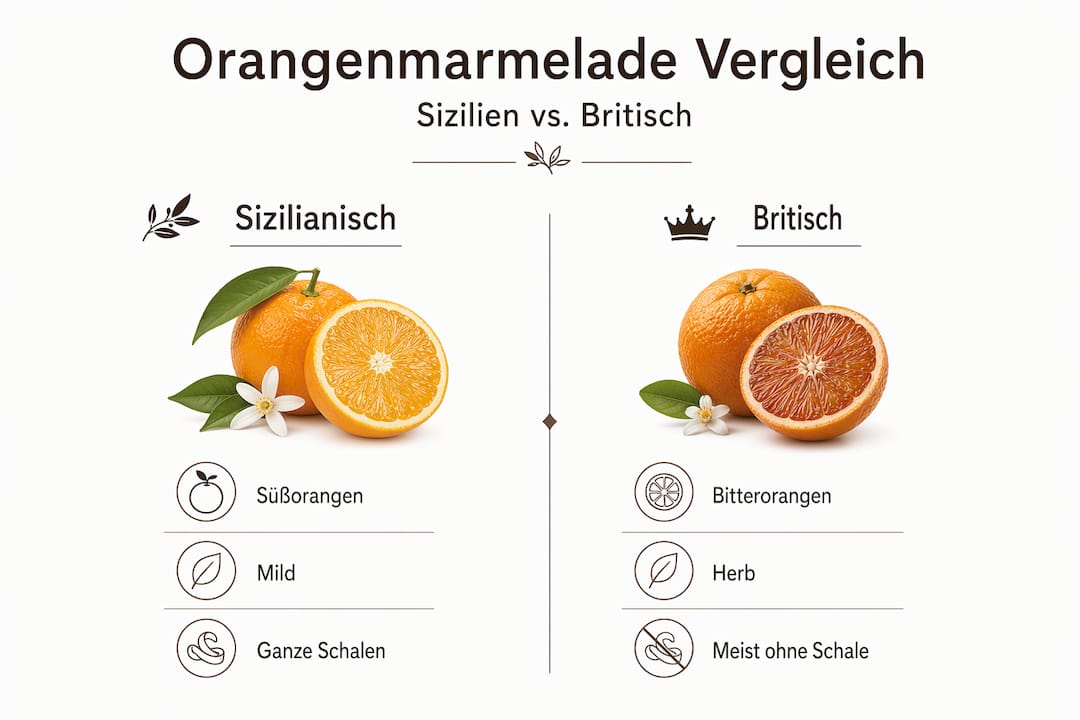
| Feature | Sicilian Marmalade | British Marmalade |
|---|---|---|
| Main fruit | Sweet oranges, blood oranges | Bitter oranges (Seville) |
| Bitterness | Mild to medium | Pronounced to strong |
| Fruit content | High (peel + pulp) | Medium (peel emphasised) |
| Colour | Orange to deep red | Golden yellow to dark brown |
| Texture | Soft, fruity | Firm, jelly-like |
| Typical use | Breakfast, cheese, desserts | Toast, breakfast |
Further differences from other global orange marmalades:
- German supermarket marmalade often uses sweet oranges without peel and relies on gelling agents for a smooth texture. The flavour is mild but flat.
- Spanish versions resemble the British tradition, as Seville oranges are native there.
- French confitures focus on high fruit content and low sugar, making them intense but less complex than Sicilian versions.
What makes Sicilian marmalade special is balance. The peel adds depth and aroma, the pulp brings juice and sweetness, and de-bittering ensures nothing overwhelms.
Regional Variations from Sicily
Sicily is not a uniform region, and this is reflected in its marmalades. Depending on which orange variety is grown in which part of the island, the character of the marmalade changes.
The best-known varieties and their impact:
- Tarocco: Sicily’s favourite blood orange. High in vitamin C, deep red flesh, and a sweet-fruity aroma with a hint of raspberry. Tarocco marmalades are especially aromatic and beautifully coloured.
- Moro: More intense than Tarocco, with deep red to violet flesh. Moro blood oranges yield fruity, aromatic, sometimes tangy marmalades with an almost berry-like note.
- Sanguinello: Milder than Moro but still with red flesh. Popular for marmalades that strike a balanced sweet-acid harmony.
- Washington Navel: A seedless sweet orange used for gentle, very fruity marmalades—ideal for first-time makers.
Regional influences go beyond variety. In eastern Sicily, around Catania and Mount Etna, oranges benefit from volcanic soil that makes the fruit more mineral and aromatic. In the south, around Ribera, oranges tend to be sweeter and juicier. These differences carry straight into the jar.
Traditional Sicilian recipes sometimes include spices such as cinnamon or cloves, rooted in the island’s Arab-Norman culinary heritage. This pairing of citrus and spice is unmistakably Sicilian and appears in no other marmalade tradition so distinctly.
Seasonal differences also matter. Blood oranges are at their peak from December to March. Marmalades made from early-harvest fruit are tangier and more aromatic, while late-harvest fruit brings extra sweetness. Anyone planning to make marmalade at home will find the best raw materials within this window.
Enjoy & Make Your Own
Understanding ingredients and process is one thing; real enjoyment begins when you twist open the lid. Sicilian orange marmalade is far more versatile than its reputation as a breakfast spread suggests.
How to recognise an authentic Sicilian marmalade when buying:
- Check the ingredient list: Orange peel and pulp should be explicitly named. A high fruit content (over 40 g per 100 g) is a good sign.
- Look at the colour: True blood-orange marmalade ranges from deep orange to reddish, not the pale yellow of common sweet-orange spreads.
- Verify origin: “Prodotto in Sicilia” or the name of a Sicilian province on the label offers guidance.
- Test the texture: Authentic marmalade contains visible pieces of peel. A smooth, homogeneous texture points to industrial processing.
In the kitchen, Sicilian orange marmalade is remarkably adaptable. On fresh bread with butter it sings in its purest form. Paired with a ripe Pecorino or Manchego, the peel’s gentle bitterness beautifully offsets the cheese’s saltiness. The adventurous can try crostini with Fontina and prosciutto crudo, where the marmalade acts as an aromatic bridge between salt, fat, and melt.
Pro tip: If you plan to make marmalade yourself, soak the peel overnight. This shortens de-bittering time the next day and leaves the peel supple.
Storage: unopened jars keep for up to two years in a cool, dark place. Once opened, refrigerate and use within four to six weeks. Jars that did not fully vacuum-seal should be used sooner.
My Experience with Sicilian Marmalade
Over the past few years I have tasted and made many orange marmalades, and one thing still surprises me: how dramatically the de-bittering step alone changes the final result.
The first time you cook marmalade with peel but skip thorough de-bittering, you end up with something almost unpleasantly bitter. No amount of sugar can fix that. Yet blanch two or three times and the flavour profile opens up. Bitterness recedes, true orange character steps forward. That is the moment you understand why Sicilian marmalade is so special.
I also learned not to underestimate the orange variety. I once used the same recipe with Washington Navel and with Moro blood oranges. The outcome was so different I could hardly believe it was the same formula. The Moro batch had depth and a faint, berry-like edge that truly excited me.
My advice for beginners: start with a mild sweet orange to learn the process, then switch to blood oranges. The difference will win you over.
— carmine
Discover Authentic Marmalade from Minnelea
If you want to taste the differences of Sicilian orange marmalade rather than just read about them, Minnelea offers a carefully curated selection of hand-crafted citrus marmalades from southern Italy.

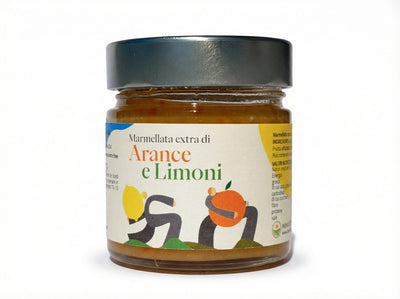
Minnelea produces in small batches using selected fruit from Cilento, a region renowned—like Sicily—for exceptional citrus. The Washington Orange Marmalade and the Orange & Lemon Marmalade show just how intense and aromatic an artisan citrus marmalade from southern Italy can be. Explore the full range in the Minnelea Marmalade Collection. Each jar is an invitation to experience the difference first-hand.
FAQ
What makes Sicilian orange marmalade special?
Sicilian marmalade uses whole peel and pulp and relies on de-bittering rather than bitter oranges, yielding an intense, aromatic profile with only gentle bitterness.
How does Sicilian differ from British orange marmalade?
British marmalade is based on bitter oranges and markedly tart. Sicilian versions use sweet or blood oranges, resulting in fruitier, more aromatic, and more approachable flavours.
Which orange varieties are used in Sicily for marmalade?
The most common are Tarocco, Moro, and Sanguinello (blood oranges) as well as Washington Navel. Each brings a unique aroma, colour, and sweet-acid balance.
How do you de-bitter orange peel at home?
Blanch the peel two or three times in fresh water, draining each time. This reduces bitter compounds from the white albedo while preserving fine orange aroma.
Which jam sugar is best for Sicilian orange marmalade?
2:1 jam sugar is the most common choice, as it adds less sweetness and lets the fruit flavour shine. Pure fruit pectin with regular sugar also works well.
Recommendations
- Cilento Orange and Lemon Marmalade · Artisan · Minnelea – Azienda Agricola Minnelea
- Cilento Washington Orange Marmalade · Artisan · Minnelea – Azienda Agricola Minnelea
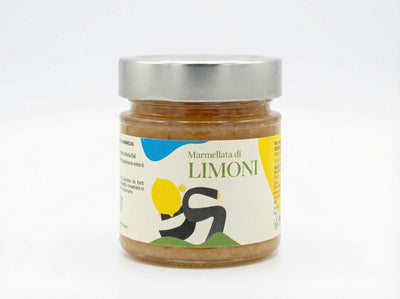
- Cilento Lemon Marmalade · WineHunter Gold · Minnelea – Azienda Agricola Minnelea
- Cilento Apricot Jam · Artisan · Minnelea – Azienda Agricola Minnelea