
Preserving Peppers: Sweet-and-Sour or in Oil — Both Methods Explained Safely
When late summer rolls around and you come home with kilos of peppers from the market, you face a fundamental choice: sweet-and-sour in vinegar (shelf-stable, crisp, a German-Austrian tradition) or roasted in oil (silky, intense, a southern-Italian tradition — but with stricter safety rules). Below you’ll find both methods step by step, with clear shelf-life guidance and none of the half-truths that circulate in many recipes.
 | From our selection Peppers in Olive OilHandmade, no preservatives. € 7,90 Discover → |
Method 1: Sweet-and-Sour in Vinegar (the Pantry Method)
The safe beginner’s route — acidity does the preserving.
For 3 × 500 ml jars: 1.5 kg peppers (mixed red and yellow), 500 ml white-wine vinegar (min. 5 %), 500 ml water, 80 g sugar, 1.5 tbsp salt, per jar: 1 garlic clove, 1 bay leaf, mustard and peppercorns.
- Core the peppers, cut into wide strips, blanch for 2 minutes.
- Bring vinegar, water, sugar and salt to a boil.
- Pack the strips tightly into sterilised jars, fill to the brim with the boiling liquor (leave 2 cm headspace).
- Water-bath for 25–30 minutes, then check the seal after cooling.
Shelf life: 6–12 months in a cool, dark place; once opened, 3–4 weeks in the fridge. Maturing time: rounded after 2 weeks, perfect after 4. (Same logic as preserving carrots — with low-acid veg, acidity is not optional.)
Method 2: Roasted in Oil (the Flavour Method)
The southern-Italian school — flavour royalty, but with higher safety demands.
- Roast and peel the peppers (full technique here).
- Blanch the strips for 2 minutes in a 1:1 vinegar-water bath — this acidification step is non-negotiable; it’s your botulism insurance.
- Dry thoroughly on kitchen towels for 2–3 hours.
- Layer with garlic and oregano in sterilised jars, cover completely with olive oil, tap out any air bubbles.
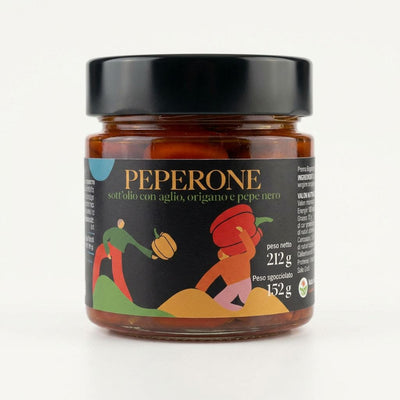
Shelf life — the honest truth: home-made jars belong in the fridge and on the table within 3–4 weeks. The months-long shelf life of commercial sott’oli relies on controlled pH testing and pasteurisation — conditions a home kitchen can’t reliably replicate. If you want that silky oil result as a pantry staple, buy it from the pros: our Peperoni Sott'Olio EVO follow this exact method — roasted southern-Italian peppers, correctly acidified, under native extra-virgin olive oil.
Which Method for Whom?
- Vinegar method: pantry staple, sandwich companion, crisp texture, large summer harvests.
- Oil method: antipasti indulgence, velvety texture, small batches for the coming weeks.
- Both: line up both jars and you’re covered from lunchtime sandwiches to full antipasti spreads.
Common Questions
Can I put raw peppers straight into oil?
No — raw, unacidified veg under oil is the textbook botulism scenario. Always acidify first (vinegar blanch), then oil.
Which vinegar?
White-wine vinegar is the classic (mild, pale). Apple-cider vinegar works; spirit vinegar is sharper. The key is at least 5 % acidity.
The peppers float — is that bad?
In the vinegar jar: weigh them down with a clean glass weight so everything stays submerged. In the oil jar: top up with oil so no piece protrudes.
Skin on or off?
Vinegar method: on (keeps them crisp). Oil method: off — roasted and peeled is the whole point of the texture.