
Soft cake with black blueberry jam: the breakfast bundt
There's a cake that never goes out of style: the soft breakfast batter, the one you keep under a dome and slice all week long. No glaze, no decoration. It just has to be moist and fragrant.
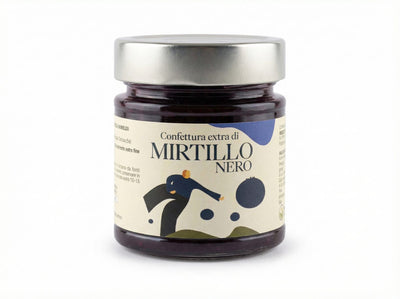
 | From our selection Blueberry JamHandmade, no preservatives. € 8,90 Discover → |
Black blueberry jam goes straight into the batter, in ribbons: as it bakes it leaves dark, moist streaks through the pale crumb, and every slice is a little different from the last. It's the simplest way to give a basic cake an identity.
Ingredients (24 cm bundt tin)
- 250 g plain flour
- 3 eggs
- 150 g sugar
- 100 ml seed oil (or 100 g melted butter)
- 125 g plain yoghurt
- 1 sachet of baking powder
- 1 pinch of salt
- zest of one lemon
- 5–6 tbsp black blueberry jam
Time: 15 minutes prep, 40 minutes baking.

Method
- Whip the eggs with the sugar until pale and fluffy: this is where the softness is decided, don't rush it.
- Add the oil, the yoghurt and the lemon zest, then the flour sifted with the baking powder and salt. Mix to a smooth batter.
- Pour half the batter into the buttered, floured tin. Drop in 3–4 spoonfuls of black blueberry jam, then cover with the rest of the batter.
- With a long skewer, make spiralling movements to create the ribbons (a marbling effect). Don't overmix: a few passes are enough.
- Bake in a static oven at 170 °C for 40 minutes. Test with a skewer at the edges: it should come out clean.
- Let it cool before turning out. To taste, a dusting of icing sugar and a few spoonfuls of jam on top once baked.
The detail that makes the difference
The jam, being heavier than the batter, tends to sink towards the bottom as it bakes. To stop it all settling underneath, two tips: keep it in concentrated ribbons (not spread evenly) and don't warm it first — the thicker it is, the better it stays suspended. A dusting of flour over the spoonfuls of jam, before covering with batter, helps even more to hold them in place.
The result: slices with well-distributed dark streaks, not a compact layer at the bottom.
Variations and pairings
For a richer cake, swap the oil for melted butter and add a handful of flaked almonds on top. In its simpler version, it's perfect as is, next to the morning coffee.
As a snack, a slice with a spoonful of Greek yoghurt and a little extra jam becomes a small plated dessert. If you want to see how many directions this jam takes beyond bakes, here are other ways to bring it to the table, from the cheese board to panna cotta.
Why black blueberry in the batter
"Jam" breakfast cakes risk being one-note: just sweet. Black blueberry brings acidity and a sharp note that, inside a soft batter, creates contrast in every slice. It's also a matter of colour: the dark streaks on pale crumb make a cake you made in ten minutes look elaborate.
Our jam is made with whole black blueberries, cane sugar and lemon juice, with no industrial pectin or colourings. The density — useful precisely for the marbling — comes from cooking under vacuum at low temperature. You'll find it among all our jams.
Frequently asked questions
Why does the jam end up all at the bottom?
Because it's heavier than the batter. Distribute it in concentrated ribbons, don't warm it and, if you like, lightly flour the spoonfuls before covering them with batter.
How long does the cake keep?
Four or five days under a dome or in a closed container. The yoghurt in the batter keeps it soft longer than butter-only cakes.
Can I use it as a layer cake to fill?
Yes. Bake it in a round tin instead of a bundt, cut into two discs and fill with more black blueberry jam and a thin layer of cream.
How much jam do I need?
5–6 spoonfuls in all: 3–4 in the batter and the rest to serve. About half a 212 g jar.