
Sun-dried tomatoes: recipes, uses, storage and how to choose them
Sun-dried tomatoes are one of the few dishes of southern Italy's peasant cuisine that wasn't born for flavor, but for the calendar: at the end of summer the harvest all arrives at once, and without refrigerators the only way to make it last until January was to remove the water. The concentrated flavor we chase today was a side effect of preservation. This guide walks through how they're made, the forms you'll find them in, how to use them, and what to look for before buying a jar.
How they're made
Tomatoes with firm, low-water flesh are used — in southern Italy, mainly San Marzano and long-keeping cluster varieties. They're cut in half lengthwise, lightly salted on the cut side, and laid in the sun on wooden racks, turned once a day. The salt serves two purposes: drawing out water through osmosis and keeping insects away.
It takes three to seven days, depending on the sun and air humidity; at night they're brought back inside, because dew would put back the moisture just removed. The tomato is ready when it's flexible but not sticky: it has lost about 90% of its water weight. Industrial hot-air tunnel drying does the same job in twelve hours, with a more uniform but less fragrant result.
Dried, in oil, or as a spread: three different products
Dry sun-dried tomatoes. Sold in bags, they're hard and very salty. They need rehydrating before use: ten minutes in hot water, or — if the dish allows — in equal parts water and vinegar, which also adds a bit of acidity back. They keep for a year in the pantry.
Oil-preserved sun-dried tomatoes. Already rehydrated and ready to use: just open the jar. The oil isn't just a preserving medium, it's part of the product — it ends up on the plate, so its quality matters as much as the tomato's.
Spreads and pâtés. These are blended sun-dried tomatoes, with or without other ingredients. Very different products go under this name, and picking the wrong one shows immediately: pâté, red pesto and sauce have textures and uses that don't overlap.
How to use them in the kitchen
The rule that always applies: a sun-dried tomato is a savory seasoning ingredient, not a vegetable. Use it the way you'd use anchovies or olives, not the way you'd use a fresh tomato.
- Raw, cut into thin strips, in grain salads, cold pasta salads, or on burrata.
- In the pan, for a quick sauce: two minutes in oil and a ladle of pasta water make the ten-minute sauce.
- Blended, with almonds and cheese, in the pesto.
- In fillings and doughs: focaccia, savory pies, meatballs. Here it should be finely chopped, or it dries out and turns leathery during cooking.
- On the cheese board, whole, alongside fresh cheeses that balance out the salt.
How to choose them: what to look for
The declared oil. “Extra virgin olive oil” and “sunflower seed oil” are two different products at the same shelf price. If the label generically says “vegetable oils,” the producer has reserved the right to change it.
The short ingredient list. Tomatoes, oil, vinegar, salt, herbs. Acidity regulators and preservatives aren't illegal or dangerous, but they signal a product designed to last long on the shelf more than to taste good.
The origin of the tomato, not of the packaging. “Packaged in Italy” says nothing about where the raw ingredient came from. If the origin isn't stated, there's usually a reason.
The appearance. A uniform dark red leaning toward brown. A red that's too bright and vivid is often a sign of very rapid drying or of a treatment.
The texture. They should give under a fork without falling apart. If they turn mushy, they were too ripe; if they stay tough, they weren't rehydrated enough.
Storage and safety
An unopened jar of oil-preserved tomatoes keeps at room temperature, away from light and heat sources, until the date on the label. Once opened, it goes in the fridge and should be eaten within two to three weeks, following one rule with no exceptions: the oil must always cover the tomatoes. Anything that pokes out oxidizes and grows mold.
Always use a clean, dry utensil to serve: crumbs and water getting into the jar are the most common cause of surface mold.
A note on botulism
Homemade oil preserves, along with low-acid vegetable preserves, are the category that Italian guidelines on home preparation pay the most attention to. The reason is that Clostridium botulinum develops in the absence of oxygen — and under a layer of oil there is none — when the environment isn't acidic enough.
The factor that makes the difference is acidification: guidance from Italy's Istituto Superiore di Sanità for home preserves calls for boiling the vegetables in a water-and-vinegar solution before jarring them, to bring the pH below the critical threshold, drying them well, and covering them completely with oil in sterilized jars. A jar that's bulging, that hisses when opened, or that smells off should be thrown away without tasting it: the toxin doesn't change the flavor and can't be seen.
If you'd rather not manage this step at home, commercial industrial and artisan products are subject to checks on acidity and preservation parameters that a home kitchen can't replicate.
Frequently asked questions
Do sun-dried tomatoes need to be desalted?
The dry ones, yes, if the dish is already savory: five minutes in lukewarm water is enough to remove the surface salt. The oil-preserved ones, no — the vinegar-and-oil step has already balanced out the salt.
How many calories do they have?
The dry ones come in around 250 kcal per 100 g, but that figure is misleading: 100 g of sun-dried tomatoes is a lot — it corresponds to more than a kilo of fresh tomatoes. The oil-preserved ones run higher because of the oil, and a realistic portion is 20-30 grams.
Can they be frozen?
The dry ones, yes, but there's no need: they already keep for a year in the pantry. The oil-preserved ones, no — freezing separates the oil and ruins the texture of the flesh.
Why are they sometimes bitter?
Almost always because of the drying: tomatoes left in the sun too long or dried at too high a temperature develop bitter notes. More rarely it's due to the oil, if it's old or has been stored in the light.
From our workshop in Cilento
It's not just about recipes: sun-dried tomatoes change the character of an entire dish, from a quick sauce to a filling.
 |
From our range
Sun-Dried Tomatoes in OilHandmade, no preservatives.
€ 7,90
Discover →
|
Sun-Dried Tomatoes in EVO Oil
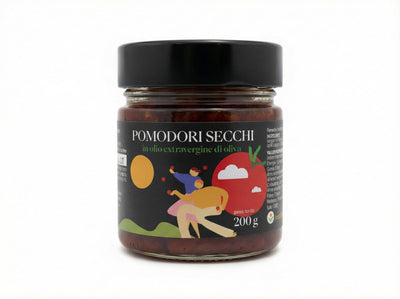
The sun-dried tomatoes from this guide: sun-dried in the South and preserved in extra virgin olive oil.
We preserve ours in oil with the same approach: produce, EVO oil, herbs. You can see them all among the artisan oil preserves from Cilento.
Discover → 7,90 €Free shipping in Italy from 27€ · 4.9★ on Google