
Styling an Antipasti Board: 7 Rules Italian Hosts Swear By
The difference between the same ingredients scattered on a board and a platter that earns an audible “Ooooh” when you walk into the room isn’t culinary skill — it’s plating know-how. Italian hosts do it instinctively; here are their rules, spelled out and in the exact order you’ll use them. (For what actually goes on the platter, see the pairing guide — this is about the how.)
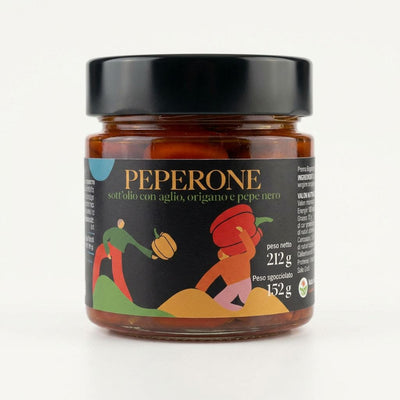
 | From our selection Peppers in Olive OilHandmade, no preservatives. € 7,90 Discover → |
Rule 1: The board is the stage — and stages are generous
Choose one large board (50 cm+) with breathing room over two small, cramped ones. Empty space between clusters isn’t a flaw, it’s a frame: it lets every element shine. Rule of thumb: keep one-third of the surface free.
Rule 2: Bowls first (the architecture)
Pros don’t start with food — they start with empty bowls: odd numbers, varied heights, scattered across the board — never symmetrical. These are the anchor points around which everything else flows. Reserve them for anything oily or juicy: peppers in olive oil, olives, confettura — placing sott’olio straight onto wood is the most common styling mishap.
Rule 3: Height beats surface
Laid flat, every ingredient looks like deli slices. Instead: fold salumi into roses (Prosciutto: loosely ruffle; salami: halve and fan), break Parmigiano by hand (irregular chunks!), stand grissini in a glass, lean crostini rather than stacking them.
Rule 4: Colour dramaturgy
Place what contrasts side by side: the red of peppers beside white cheese, dark olives next to pale bread, green (basil, a nest of rocket) as a divider between beige zones. Quick test: from two metres away you should still spot at least four colours.
Rule 5: The nibbling logic (everything within reach)
Every component must be grabbable without utensil acrobatics: cheese pre-cut, salumi pre-folded, a tiny spoon in every bowl, toothpicks visible. If the first guest has to ask how to take something, the board is pretty — but it has failed.
Rule 6: The 20-minute temperature rule
The invisible rule with the biggest flavour payoff: assemble the platter, then let it rest 20–30 minutes at room temperature (covered). Cheese releases its aroma, the olive oil in the sott’oli turns liquid and glossy — fridge-cold antipasti are mute.
Rule 7: The final flourish
Just before serving: a thin thread of olive oil over cheese and vegetables, a twist of fresh pepper, one or two herb sprigs (rosemary, basil) laid diagonally. This 30-second step is the difference between “prepared earlier” and “made for you right now”.
Build order cheat-sheet
- Position the board, scatter the bowls (Rule 2)
- Fill the bowls
- Place cheese chunks in 2–3 clusters
- Tuck salumi roses into the gaps
- Edge the board with bread/grissini/crostini
- Colour-check from a distance (Rule 4)
- Let it temper, add oil finish, serve
For seated menus instead of convivial boards: the single antipasti plate follows the same rules in miniature.
FAQs
Wood, marble or slate? Light wood and marble make colours pop; slate can feel dark-rustic fast. More important than the material: size and bowls.
How do I keep the board from looking ravaged after 20 minutes? Keep refill reserves in the kitchen instead of piling mountains on the board — and the bowl architecture will hold the structure even as the surface empties.
Decor yes or no? Edible décor yes (herbs, grapes), scatter décor no. Everything on the board must be edible — an Italian non-negotiable.