
Calabrian Chili: Origin, Flavour and How to Use It
The Peperoncino Calabrese, known in English as Calabrian Chili, is a small, vivid red fruit of the Capsicum annuum species from southern Italy. Its flavour profile is fruity, subtly smoky, and underpinned by a pleasant sweetness that sets it apart from other chilli varieties. According to Pepperscale, the heat registers at 25,000–40,000 SHU (Scoville Heat Units), placing it in the medium to robust range. In commerce, it appears in four main forms:
- Fresh: intensely aromatic, for immediate use
- Dried or as flakes: concentrated flavour, long shelf life
- Preserved in oil (whole or chopped): milder aroma, ready to use
- As paste (Pâte di Peperoncino): easily adjustable dosage, ideal for sauces and marinades
Typical dishes where it plays a starring role: the spreadable sausage 'Nduja, Pasta all'Arrabbiata, pizza with salami, antipasti, and spicy aioli. Once tasted, one quickly understands why it is considered indispensable in southern Italian cooking.
Pro tip: Start with a small amount of paste, roughly half a teaspoon per portion, and build up gradually. The heat of this peperoncino arrives with a delayed kick.
Table of Contents
- Why does Calabrian Chili taste so special? The climate and terroir of Calabria
- How hot is Calabrian Chili really? Flavour profile and Scoville comparison
- What forms does Calabrian Chili come in and how long does it keep?
- How do you use Calabrian Chili in the kitchen? Recipes and dosage
- Making Calabrian chilli paste yourself: step by step
- Where to buy Calabrian Chili in Germany? Sources and quality indicators
- Why "Calabrian" makes a difference: Quality criteria from a producer's perspective
- Key takeaways
- What I truly appreciate about Calabrian Chili
- Artisan peppers and antipasti from Minnelea
- Further reading and recommended articles
Why does Calabrian Chili taste so special? The climate and terroir of Calabria
Calabria forms the toe of Italy's boot, nestled between the Tyrrhenian and Ionian Seas. This microclimate brings over 300 days of sunshine a year, hot dry summers, and mineral-rich soils of volcanic origin. It is precisely this combination that drives up the sugar content of the fruit and gives the peperoncino its characteristic fruitiness.
The maritime climate also lends a subtle saline note to the aroma, particularly noticeable in oil-preserved varieties. Anyone who has tasted a Calabrian peperoncino straight from the bush recognises immediately: this is no generic chilli. The fruit tastes of the place where it grew.
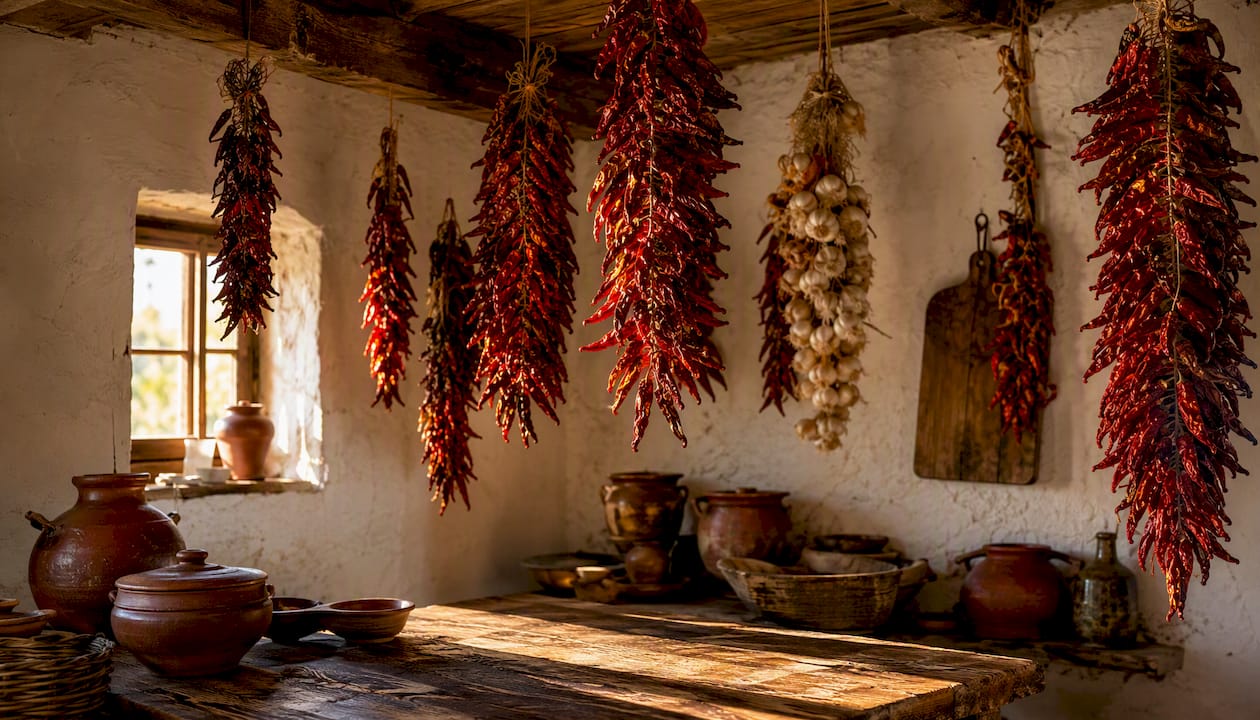
Culturally, the peperoncino is omnipresent in Calabria. Whole garlands of dried pods hang from house façades and in kitchens, not merely as decoration but as stores for winter. Agricola Conforti describes it as an everyday seasoning present in nearly every Calabrian kitchen, one that does not dominate dishes but elevates them.
Pro tip: When buying quality produce, look for a vivid red colour without brown spots and an intense, fresh-spicy aroma. Pale or dull pods indicate poor storage or inferior harvest.
How hot is Calabrian Chili really? Flavour profile and Scoville comparison
25,000–40,000 SHU according to Pepperscale. This corresponds to three to five times the heat of a jalapeño (typically 2,500–8,000 SHU) and sits just below cayenne pepper (30,000–50,000 SHU).
However, various sources cite differing values. Tasting Table explains that these variations stem from different measurement methods, harvest times, and cultivars. The commonly accepted range for Calabrian Chili, according to Pepperscale, is 25,000–40,000 SHU.
| Chilli variety | Scoville range (SHU) | Flavour profile |
|---|---|---|
| Jalapeño | 2,500–8,000 | Grassy, fresh, mild |
| Calabrian Chili | 25,000–40,000 | Fruity, smoky, sweet |
| Cayenne pepper | 30,000–50,000 | Hot, dry, little fruit |
| Serrano | 10,000–23,000 | Fresh, slightly bitter |
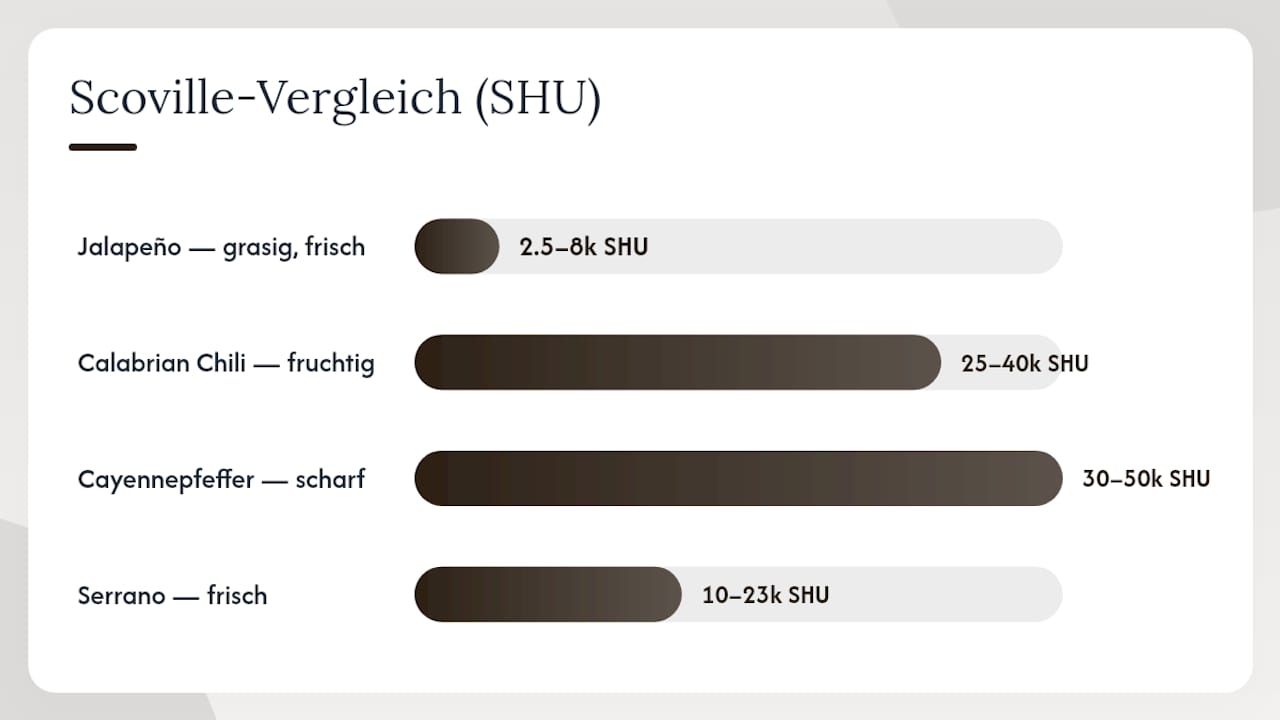
What distinguishes Peperoncino Calabrese from cayenne is less the heat than the flavour profile. The fruitiness carries the warmth rather than masking it. Chefs particularly value it in combination with fatty ingredients such as cheese or cream sauces, where the fruity-sweet finish emerges with particular elegance.
What forms does Calabrian Chili come in and how long does it keep?
The Spruce Eats summarises the commercial forms and their shelf life clearly. Sealed glass jars keep for approximately one year; opened jars last several months in the refrigerator, provided the chillies remain covered with oil.
| Form | Advantage | Disadvantage | Shelf life |
|---|---|---|---|
| Fresh | Most intense aroma | Short shelf life, difficult to find | A few days |
| Dried / flakes | Long-lasting, easy to dose | Less fruitiness | Approximately one year |
| In oil (whole/chopped) | Ready to use, aromatic | Must be refrigerated after opening | Unopened ~1 year |
| Paste | Very versatile, evenly dosable | More intense, less texture | Opened several months/refrigerated |
| Powder | Practical for dry blends | More volatile aroma | Approximately one year |
Those who preserve chillies in olive oil extend the shelf life whilst simultaneously gaining a flavoured oil excellent for pasta or bruschetta.
- Store dried produce in a dark, cool, dry place—not in the refrigerator.
- Always cover opened glass jars with a layer of oil.
- Consume paste within two to three months of opening.
How do you use Calabrian Chili in the kitchen? Recipes and dosage
The Kitchn describes its versatility aptly: paste, whole preserved pods, and flakes can be employed in entirely different contexts without requiring a new recipe each time.
Typical dishes and applications:
- 'Nduja: The Calabrian spreadable sausage contains peperoncino as a core ingredient. On bruschetta, as a pizza topping, or melted into pasta sauces.
- Pasta: A teaspoon of paste transforms Aglio e Olio into a fiery, fruity variation. For a quick tomato sauce, half a pod, finely chopped, suffices.
- Pizza: Those who love 'Nduja pizza know the principle. Without 'Nduja, two to three chopped preserved pods make an excellent topping. For recipe ideas around Nduja pizza, it is worth exploring preparation variations with mozzarella and salami.
- Antipasti and marinades: Whole pods in oil pair beautifully with cheese boards, olives, and grilled vegetables. A peperonata gains considerable depth from a pinch of flakes.
- Aioli and dips: A teaspoon of paste stirred into homemade mayonnaise creates a piquant accompaniment to seafood or vegetables.
Dosage guidelines by form:
- Paste: 0.5–1 teaspoon per portion as a starting point
- Flakes: 0.5–1 teaspoon per dish, added at the end of cooking
- Whole preserved pods: 1–2 per portion, finely chopped
Pro tip: Add paste directly to hot olive oil and sauté briefly before adding other ingredients. This allows the aroma to develop fully and distributes the heat evenly throughout the dish.
Making Calabrian chilli paste yourself: step by step
Sternestulle provides a proven step-by-step method that has stood the test of practice.
Ingredients for approx. 200 g paste (based on Italian Traditions):
- 200 g fresh red chillies (Peperoncino Calabrese or similar variety)
- 1 tsp coarse sea salt
- 3–4 tbsp extra virgin olive oil
- Optional: 1 splash white wine vinegar, 1 small garlic clove
- Wash and dry chillies. Remove stems; leave seeds in for more heat or remove for milder paste.
- Salt and drain. Roughly chop chillies, mix with salt, and leave to drain overnight in a sieve. This removes moisture and concentrates the aroma.
- Process. The next day, purée the drained chillies finely in a blender or with an immersion blender.
- Work in oil. Add olive oil tablespoon by tablespoon until a spreadable, homogeneous paste forms. Optionally mix in vinegar and garlic.
- Fill into sterilised jars. Boil jars for 5 minutes beforehand. Fill with paste, cover with a layer of oil, seal tightly.
Safety note: Always wear disposable gloves when handling fresh chillies. Capsaicin adheres stubbornly to skin and can irritate eyes and mucous membranes hours later.
The finished paste keeps for several months in the refrigerator, provided the surface is covered with fresh oil after each use.
Where to buy Calabrian Chili in Germany? Sources and quality indicators
Authentic Calabrian products are readily available in Germany if one knows where to look.
Purchase checklist:
- Origin indication "Calabria" or "Peperoncino Calabrese" on the label
- Short ingredient list: chillies, oil, salt. Nothing more is needed.
- Vivid red colour, no brown, no dull sheen
- Clear to slightly cloudy oil in the jar, never rancid-smelling
- No artificial preservatives or colourings
Sources in Germany:
| Source | Suitability | Note |
|---|---|---|
| Fine food shops / delis | Very good | Often curated selection, advice available |
| Italian speciality shops | Very good | Frequently direct import goods |
| Online shops (e.g. Minnelea) | Good | Transparent origin, small batches |
| Supermarket | Limited | Usually generic quality, little provenance information |
Minnelea offers with its Cilento Peppers in EVOO an artisan example of preserved peperoni in extra virgin olive oil, made in small batches from regional ingredients. Those wishing to better understand quality marks such as DOP or IGP can also find an overview of southern Italian designations of origin at Minnelea.
Storage after purchase:
- Store unopened glass jars in a cool, dark place
- After opening: refrigerator, always keep chillies covered with oil
- Dried produce and flakes: airtight, dark, at room temperature
Why "Calabrian" makes a difference: Quality criteria from a producer's perspective
Quality begins with the selection of raw materials. Those who craft artisan antipasti know: a pod ripened under optimal conditions needs no additives. The aroma carries itself.
At Minnelea, we follow this principle consistently: each batch is made with regional ingredients from southern Italy, the recipes are traditional, and processing occurs in small quantities to preserve freshness and aromatic intensity. This is not exceptionalism, but craft as it should be.
Recognising marks of genuine producer quality:
- Complete origin indication (region, ideally producer)
- Traditional recipe without stabilisers
- Visible texture in the paste or jar (not homogenised mass)
- Olive oil as the sole preserving medium
Pro tip: A quality extra virgin olive oil as the carrier oil not only improves shelf life but transfers its own aroma to the chillies. A high-quality olive oil spray is also excellent for evenly covering homemade paste with a thin layer of oil.
Key takeaways
The Peperoncino Calabrese combines fruity aroma, medium to robust heat, and versatile applicability in a single product that remains undervalued in German fine food cooking.
| Topic | Details |
|---|---|
| Heat and aroma | 25,000–40,000 SHU; fruity, smoky, sweet; milder finish than cayenne |
| Main commercial forms | Fresh, dried, in oil, as paste; paste is the most versatile form for home cooking |
| Typical applications | 'Nduja, pasta, pizza, antipasti, aioli; use paste measured (0.5–1 tsp per portion) |
| Purchase and storage | Check origin "Calabria" on label; store opened jars refrigerated and covered with oil |
| Minnelea recommendation | Cilento Peppers in EVOO: artisan, small batches, transparent southern Italian ingredients |
What I truly appreciate about Calabrian Chili
Most articles about hot peppers from Calabria end with a warning: "Careful, very hot!" This falls short. Those who view Peperoncino Calabrese merely as a source of heat miss the essential.
What fascinates me about this chilli is its layering. The fruitiness comes first, then the warmth, and finally a subtle smoky aftertaste that keeps a dish interesting minutes after the last bite. This is not an effect achieved with supermarket chilli powder.
My personal favourite application: a teaspoon of paste in a simple tomato sauce, with good hard cheese and pasta. No ten ingredients, no complicated technique. But the result tastes of Calabria.
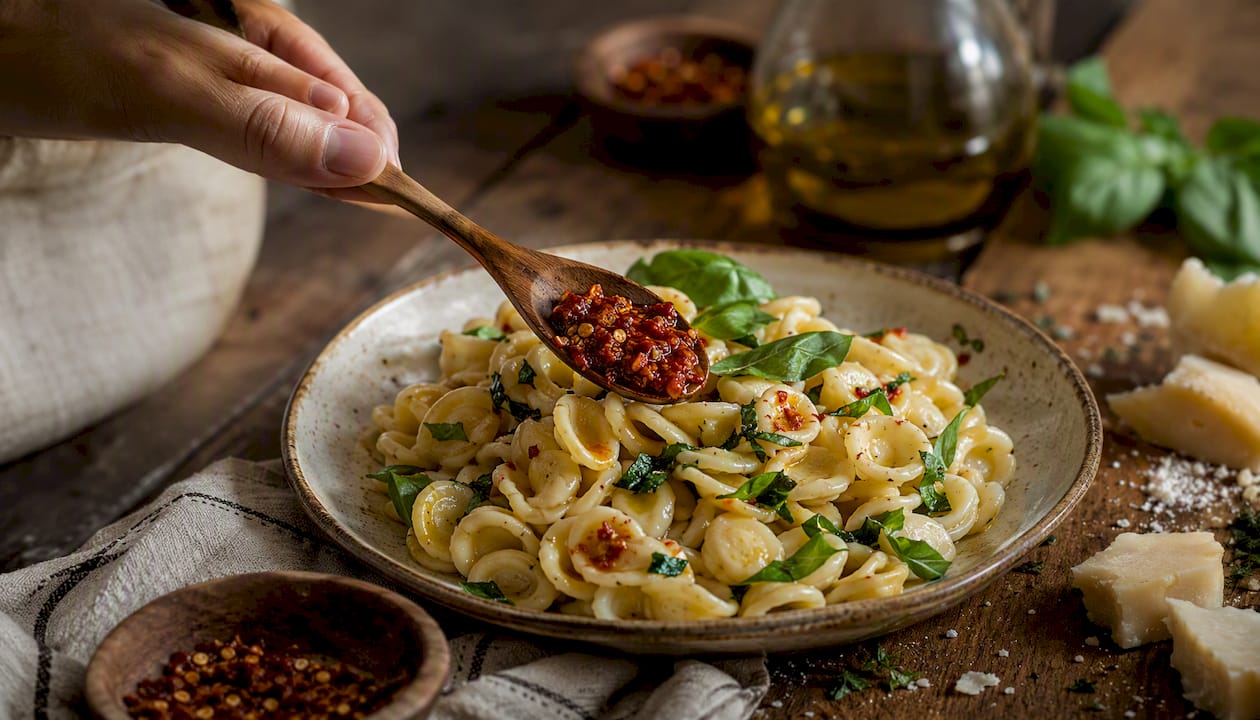
What I also observe: many home cooks buy paste once, try it in one recipe, and then let the jar languish in the refrigerator. This is a shame. Paste works in aioli, in marinades, on pizza, in soups. It is not a speciality product for a single dish, but an everyday seasoning that elevates an entire kitchen.
And once one has understood what terroir tastes like, one never buys generic again.
Artisan peppers and antipasti from Minnelea
Those who wish to experience authentic Calabrian flavours in their own kitchen without spending hours searching for reliable import goods will find a direct answer at Minnelea. Our Cilento Peppers in EVOO are artisan-made, in small batches, with selected peperoni from southern Italy and extra virgin olive oil as the sole preserving medium. No additives, no lengthy ingredient lists.

Those who appreciate the combination of antipasti and preserved vegetables will find with our Cilento Aubergines in EVOO a further artisan complement for cheese boards, bruschetta, or Mediterranean appetisers. Both products are available through our online shop and also make excellent gifts for gourmets. View the current selection directly at minnelea.com.
Further reading and recommended articles
For those wishing to delve deeper into the subject, these sources are particularly recommended:
- Pepperscale: Calabrian Pepper Guide — Scoville data, flavour description and quick facts on the variety; good entry point for heat comparisons.
- The Spruce Eats: What Are Calabrian Chiles? — Overview of commercial forms, shelf life and storage recommendations; practical for everyday use.
- The Kitchn: What Are Calabrian Chiles? — Recipe ideas and application tips; particularly useful for beginners.
- Tasting Table: How Calabrian Chiles Get Their Heat — Background on heat development and explanation of source variance in SHU figures.
- Agricola Conforti: Calabrian Chilli — Producer perspective; traditional use, cultural role and preservation methods from first hand.
- Sternestulle: Allzweckwaffe Kalabrische Chilipaste — Practical step-by-step guide to homemade paste with canning tip.
- Italian Traditions: Kalabrische Chilisauce — Concrete quantities and recipe variations for processing fresh chillies.
Recommendation
- Chillies in oil: varieties, Scoville scale and uses in cooking – Azienda Agricola Minnelea
- Peperonata: Recipe & quick version from the jar – Azienda Agricola Minnelea
- Typical ingredients of southern Italian cuisine: The guide – Azienda Agricola Minnelea
- Cilento Spicy Tomato Sauce with Chili · Minnelea – Azienda Agricola Minnelea