
Regional Recipes from Southern Italy: Highlights for Gourmet Chefs
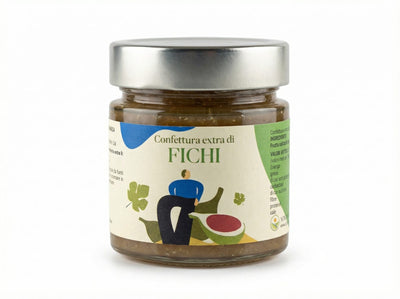
 | From our selection Fig JamHandmade, no preservatives. € 7,90 Discover → |
Southern Italian cuisine is among the most diverse and storied in Europe, yet anyone in Germany searching for genuine examples of regional recipes from Southern Italy quickly runs into a problem: the internet is flooded with adapted versions that have lost their regional soul. Which dishes truly represent Sicily, Calabria, or Cilento? Which ingredients are non-negotiable, and which techniques make all the difference? This article brings clarity. We present carefully chosen traditional recipes, explain their cultural roots, and give you practical preparation tips that go far beyond the obvious.
Table of Contents
- Key Takeaways
- 1. Criteria for Authentic Regional Recipes from Southern Italy
- 2. Pasta alla Norma: The Heart of Sicilian Cooking
- 3. Seppie Ripiene alla Lucana: Seafood from Basilicata
- 4. Sicilian Caponata: The Sweet-and-Sour Vegetable Dish
- 5. Arancini: The Rice Balls with Regional Identity
- 6. Cannoli: Quality Starts with the Filling
- 7. Pasta con le Sarde: Sicily’s Arab Legacy on the Plate
- 8. Muddica Atturrata: The Underestimated Technique of Cucina Povera
- 9. Comparison of the Featured Recipes
- 10. Recommendations for Preparation, Storage & Serving
- My View on Regional Recipes from Southern Italy
- Minnelea: Real Ingredients from Cilento for Authentic Cooking
- FAQ
Key Takeaways
| Point | Details |
|---|---|
| Simplicity as a Quality Marker | Authentic southern-Italian dishes rely on a handful of premium regional ingredients rather than complexity. |
| Respect the Resting Time | Dishes like caponata only reach their full flavour after 8–24 hours in the fridge. |
| Ingredient Sourcing is Critical | Ricotta Salata, Sicilian aubergines, and good olive oil are irreplaceable—start with quality. |
| Cultural Context Enriches | Arab, Greek and Norman influences still shape the flavour language of Southern Italy today. |
| Technique Before Recipe | Methods such as muddica atturrata or adding warm fish stock while braising are the real keys to authenticity. |
1. Criteria for Authentic Regional Recipes from Southern Italy
Before you cook a recipe from Southern Italy, it’s worth taking a critical look at its provenance. Not every pasta dish with tomato sauce is an authentic plate that truly represents a region. Authentic southern-Italian dishes are defined above all by a focus on high-quality, regional raw materials rather than unnecessary complexity.
What distinguishes real regional recipes:
- Region-typical ingredients such as Ricotta Salata from Sicily, ’Nduja from Calabria, Friggitelli peppers from Campania or cold-pressed olive oil from Cilento. These products are available in Germany through specialist delicatessens or online.
- Traditional cooking techniques without shortcuts: slow braising, preserving in olive oil, roasting ingredients. These steps are often omitted in quick recipe versions.
- Seasonal alignment: true scallop salad belongs to summer, sea urchins to the winter months from October to April. Ignoring this is to miss the region’s reality.
- Historical context: Arab influences on southern-Italian cuisine show up in spices like cinnamon in pasta sauces or raisins and pine nuts in savoury dishes. Knowing this helps you understand why a recipe works the way it does.
Pro tip: Never buy pre-grated Ricotta Salata. Buy it whole and grate it fresh over the dish; the flavour profile is completely different—salty, slightly dry, almost nutty.
2. Pasta alla Norma: The Heart of Sicilian Cooking
No dish is more emblematic of recipes from Sicily than Pasta alla Norma. Born in Catania, it combines fried aubergine, tomato sauce, fresh basil and grated Ricotta Salata. The name pays homage to Vincenzo Bellini’s opera “Norma,” a famous son of Catania. 23 September is celebrated as the Giornata Nazionale della Pasta alla Norma.
The critical step many home cooks skip: draining the aubergines. Salting for at least 20 minutes before frying draws out bitterness and dramatically improves texture. Skip this and you’ll get soggy, oil-laden cubes instead of golden, flavour-packed pieces that truly sing on olive-oil pasta.
Ingredients for 4:
- 400 g Rigatoni or Spaghetti (Rigatoni is traditional in Catania)
- 2 medium, firm aubergines, diced and salted
- 400 g San Marzano tomatoes, peeled
- 2 garlic cloves, extra-virgin olive oil, basil
- 80 g Ricotta Salata, freshly grated
The tomato sauce needs at least 20 minutes over medium heat to develop depth. The aubergines are fried separately in plenty of olive oil—never baked. Only when serving is the Ricotta Salata added: never in the pan.
3. Seppie Ripiene alla Lucana: Seafood from Basilicata
Stuffed squid is a shining example of Southern Italian seafood recipes barely known in Germany. Basilicata has only a short coastline, yet its seafood dishes display a confident hand with the sea. The stuffing is made of breadcrumbs, parsley, garlic, capers and grated Pecorino. Some versions add pine nuts, revealing the Arab influence felt across the region.
The secret lies in the cooking method: seppie ripiene are baked at 200 °C for about 30 minutes, with warm fish stock regularly spooned over the squid. Adding warm stock while braising is not optional; it keeps the flesh moist and prevents drying. Cold liquid would interrupt the cooking process and ruin the texture.
Pro tip: Ask your fishmonger to clean the squid but keep the ink sacs. A small spoonful of ink in the stuffing lends a deep maritime note and dramatic colour.
4. Sicilian Caponata: The Sweet-and-Sour Vegetable Dish
Caponata is not mere aubergine stew. It is a composition in which sweetness, acidity, saltiness and umami must balance precisely. The classic Sicilian version includes aubergines, celery, onions, olives, capers, tomatoes, vinegar and sugar. Pine nuts and raisins are not modern add-ons but traditional components that trace directly to Arab influence.
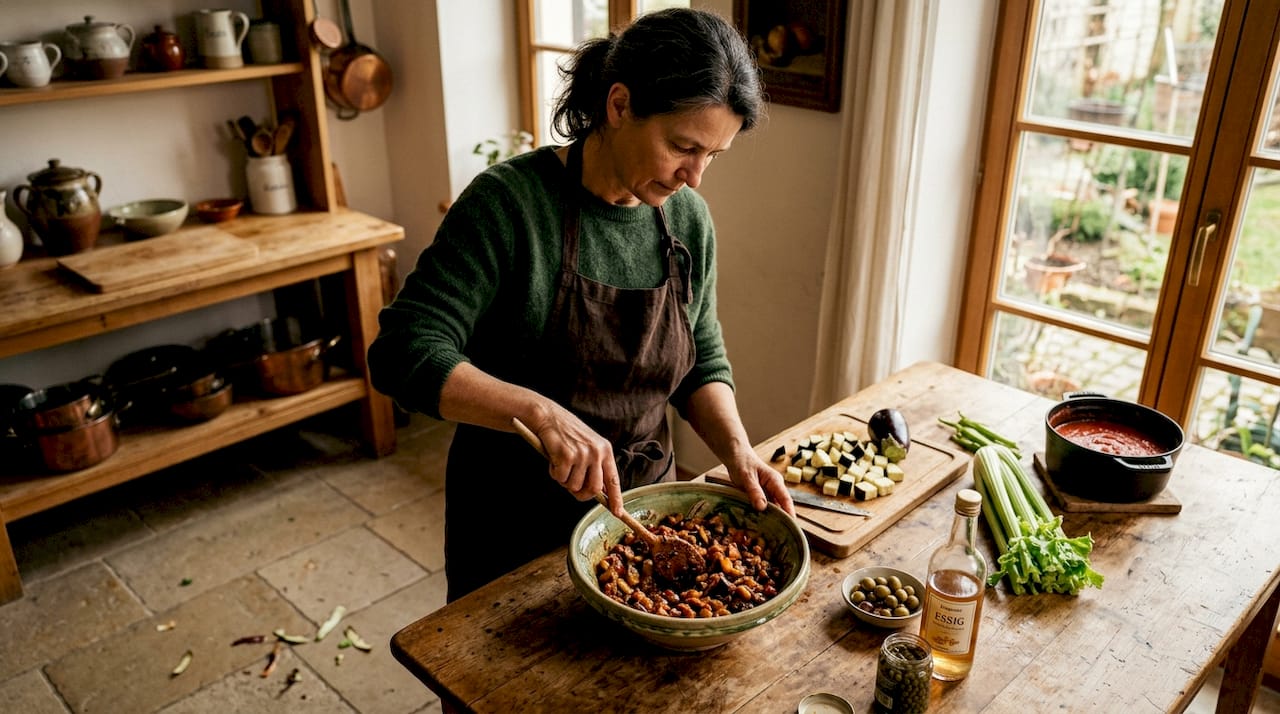
The decisive tip: Caponata should rest for 8–24 hours in the fridge before serving. Freshly made it tastes flat. Overnight, the flavours marry, the vinegar mellows. Caponata is one of the few dishes that is unquestionably better on the second day.
It works as an antipasto, a side to grilled fish, or as a bruschetta topping. Like preserved zucchini sott’olio, it keeps for several days in the fridge without loss of quality.
5. Arancini: The Rice Balls with Regional Identity
Arancini are typical Southern Italian street food found across Sicily, but the idea that there is only one version is fundamentally wrong. In Palermo they are called “arancina,” round like an orange. In Catania they are “arancino,” cone-shaped and often pointed. The shape is no accident: the Catania cone is said to symbolise Mount Etna.
Classic fillings vary widely:
- Ragù (beef mince, peas, tomato sauce): the most common version, typical of Catania
- Burro (butter, ham, béchamel): a richer, creamier variant, more popular in Palermo
- Spinaci e ricotta: a vegetarian Southern Italian recipe that is standard in many homes
Breading is a multi-step process: flour, egg, breadcrumbs, then egg and breadcrumbs again. Only this creates the characteristic thick crust that withstands hot oil. Fry at 175 °C until the shell is deep gold and evenly browned.
6. Cannoli: Quality Starts with the Filling
Cannoli are the most famous dessert of southern-Italian cuisine, yet most versions served outside Sicily miss the point. Authentic cannoli are filled to order so the crisp shell keeps its texture. Pre-filled cannoli that sit in a display case for hours are a quality issue, not an offering.
The filling is made with Ricotta di Pecora (sheep’s-milk ricotta), icing sugar, sometimes a hint of vanilla and, in Sicily, almost always candied fruit and Bronte pistachios. The Bronte pistachio is not a replaceable topping: it has a deeper, more intense aroma than imported varieties and gives the cannolo its signature green finish.
For home preparation: buy fresh shells from a specialist or make your own, and fill them just before serving. The ricotta mixture can be prepared a few hours ahead but must stay well chilled.
7. Pasta con le Sarde: Sicily’s Arab Legacy on the Plate
Pasta con le Sarde is a regional Italian dish that tells Sicily’s history in a single bite. Fresh sardines, wild fennel, saffron, raisins and pine nuts: this is no random combination but a direct legacy of the Arab cuisine that shaped Sicily in the 9th and 10th centuries. The Arab influence on sweet-savoury flavours is nowhere clearer than in this dish.
Wild fennel is hard to find in Germany. Cultivated fennel with its fronds is an acceptable substitute, but wild fennel has a more intense, slightly bitter note that completes the dish. If you spot it at a farmers’ market or well-stocked deli, grab it.
The dish is traditionally made with bucatini. The sauce is deliberately left coarse—pieces of sardine, fennel fronds and soft raisins should remain visible in the finished dish.
8. Muddica Atturrata: The Underestimated Technique of Cucina Povera
Anyone serious about traditional recipes from Southern Italy cannot ignore muddica atturrata. These are toasted breadcrumbs aromatised in olive oil, sometimes with anchovy or peperoncino. Muddica atturrata is known as the “poor man’s Parmesan,” historically used when expensive cheese was unavailable.
Today the technique is no longer a makeshift measure but a deliberate flavour choice. The toasted crumbs give pasta dishes a nutty, crunchy texture no cheese can replicate. They are sprinkled over pasta con le sarde, pasta alle vongole or simple aglio-e-olio variations. Toasting takes only a few minutes but demands constant stirring—breadcrumbs burn quickly.
Pro tip: Use day-old bread you’ve coarsely ground yourself. Industrial breadcrumbs are too fine and evenly toasted. Homemade crumbs have irregular pieces that caramelise differently and add more complexity.
9. Comparison of the Featured Recipes
| Dish | Region of Origin | Main Ingredients | Preparation Time | Special Note |
|---|---|---|---|---|
| Pasta alla Norma | Sicily (Catania) | Aubergines, Ricotta Salata, tomato sauce | ~45 min | Aubergines must be drained |
| Seppie Ripiene | Basilicata | Squid, breadcrumbs, Pecorino | ~50 min | Add warm fish stock while baking |
| Caponata | Sicily | Aubergines, capers, vinegar, raisins | 30 min + 12 h resting | Better on the second day |
| Arancini | Sicily (varies) | Risotto rice, ragù or burro | ~90 min | Shape reveals the region |
| Cannoli | Sicily | Sheep’s-milk ricotta, candied fruit, pistachios | 30 min + resting | Fill only to order |
| Pasta con le Sarde | Sicily | Sardines, wild fennel, saffron, raisins | ~40 min | Arab spice heritage |
If you must substitute in Germany: Ricotta Salata can be replaced in a pinch by aged, dry feta left uncovered in the fridge for a few hours. It’s not identical, but closer to the original than grated Parmesan. Wild fennel can be approximated with fennel fronds plus a pinch of fennel seed or anise.
10. Recommendations for Preparation, Storage & Serving
If you take authentic Italian dishes from Southern Italy seriously, you take time for preparation. Most mistakes happen before the actual cooking.
Key principles:
- Always drain aubergines: salt for at least 20–30 minutes, rinse and pat dry. This applies to both Pasta alla Norma and Caponata.
- Prepare caponata a day ahead: ideally cook the day before and chill overnight. It keeps up to five days in the fridge and gains depth daily.
- Keep cannoli filling cold: let the ricotta mixture rest at least two hours to settle, then give it a quick stir before piping.
- Make your own fish stock for seppie: simmer fish heads, celery, bay and white wine for 30 minutes for an aromatic stock far better than any cube.
Pro tip: Use extra-virgin olive oil from Cilento or Sicily for these dishes. The oil is not a neutral base but a flavour carrier. A fruity, lightly bitter oil gives caponata and Pasta alla Norma a depth no supermarket bargain can match.
For sourcing genuine regional products in Germany, seek out specialist importers, well-stocked delicatessens and selected online retailers who work directly with small Southern-Italian producers.
My View on Regional Recipes from Southern Italy
Over the years I’ve watched cooks in Germany stumble with Southern-Italian recipes not because of poor technique, but because of impatience. They skip draining the aubergines, serve caponata the same day, or buy industrial ricotta instead of Ricotta di Pecora.
What excites me about Southern-Italian cuisine is the honesty of its simplicity. A dish like Pasta con le Sarde needs no elaborate plating. It needs good sardines, wild fennel, real saffron. That’s it. Authenticity is revealed in this restraint, not in long ingredient lists.
Something I’ve often seen underestimated: the muddica atturrata technique. It’s not a poverty trick; it’s a deliberate choice for texture and depth that I make in my own kitchen even when Parmesan is available. And the idea of making cultural history tangible through spices like cinnamon and raisins in savoury dishes—that is what separates Southern-Italian cooking from a mere collection of recipes.
Modern adaptations are fine. But you should know what you are adapting and why. Knowing the original is the prerequisite for changing it with respect.
— carmine
Minnelea: Real Ingredients from Cilento for Authentic Cooking
If you want to prepare the recipes above at a high level, you know the ingredient is decisive. At Minnelea we craft small-batch artisanal specialities from Cilento in Southern Italy, made precisely for these dishes.

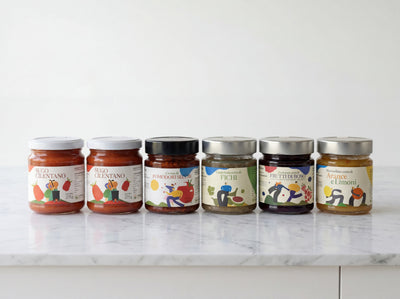
Our Melanzane sott’olio—aubergines preserved in extra-virgin olive oil—are a direct link to recipes like Pasta alla Norma or Caponata. They save time without compromising quality or authenticity. For pasta dishes we recommend our Cilento tomato sauce, prepared according to traditional recipes from selected regional tomatoes and as close to the original as a jar can be.
Every product arrives with the story of its origin, elegantly packaged and ideal as a gift for gourmet cooks and connoisseurs. Discover the curated range directly at minnelea.com.
FAQ
What are typical regional recipes from Southern Italy?
Typical examples of regional recipes from Southern Italy include Pasta alla Norma from Catania, Sicilian Caponata, Cannoli, Arancini, Pasta con le Sarde and Seppie Ripiene from Basilicata. Each dish reflects the regional ingredients and historical influences of its origin.
What makes Southern-Italian recipes authentic?
Authentic Southern-Italian recipes are defined by high-quality, regional staples such as Ricotta Salata, cold-pressed olive oil and fresh seafood, combined with traditional techniques like slow cooking or draining aubergines.
How long should caponata rest?
Caponata should rest for at least 8–24 hours in the fridge before serving. Only then do the sweet-and-sour flavours fully develop and the vegetable texture become optimal.
What is muddica atturrata and how is it used?
Muddica atturrata are toasted breadcrumbs aromatised in olive oil. They are sprinkled over pasta dishes as an affordable, textural alternative to Parmesan and are central to Southern Italy’s cucina povera.
Where can I find typical Southern-Italian ingredients in Germany?
Ricotta Salata, ’Nduja, wild fennel and premium olive oils from Cilento or Sicily can be found in well-stocked delicatessens, Italian speciality shops or online stores like Minnelea that work directly with small Southern-Italian producers.