
Making Tomato Paste at Home: the Old Way — and the Smarter Shortcut
In Sicily it is called estratto or strattu: tomato paste, spread on wooden boards under the August sun and rays and stirred until ten kilos of tomatoes collapse into a single kilo of dark, almost kneadable essence. It is one of Italy’s most venerable preservation rituals — and one that can only be approximated at home. Here is the original, the home version, and the candid answer to when you should simply let it be.
 | From our selection Fig JamHandmade, no preservatives. € 7,90 Discover → |
The Original: Strattu from Sicily
The traditional method in brief: cook the tomatoes, pass them (as you would for Passata), salt — then spread the purée on large boards under fierce sun for days, turning and kneading several times daily until 90 % of the water has vanished. The result is nothing like the stuff in a tube: strattu is darker, saltier, almost meaty in umami, and treated like a spice. Requirements: 35 °C, dry wind, a week of steady weather — the Sicilian climate is part of the recipe, and that is exactly where the method fails north of the Alps.
The Home Method: Oven Concentrate
What works at home is oven reduction:
- Make Passata from 3 kg of ripe plum tomatoes (or use good purchased Passata — see the honest calculation below).
- Simmer the Passata in a wide pot until reduced by half (about 1 hour, uncovered, stirring often).
- Spread the thick mass on a deep tray and dry at 90–100 °C for 4–6 hours, turning and re-spreading every hour, until you have a spreadable, dark-red paste.
- Knead in 2 % salt, pack into small sterilised jars, seal the surface with olive oil. Keeps 2–3 months in the fridge.
The honest calculation: 3 kg tomatoes (€9–12) plus 6–7 hours of pot and oven time yield about 250–300 g of paste. Flavour-wise it beats any tube — but it is a labour of love, not a pantry plan.
The Smarter Shortcut: same function, already sun-ripened
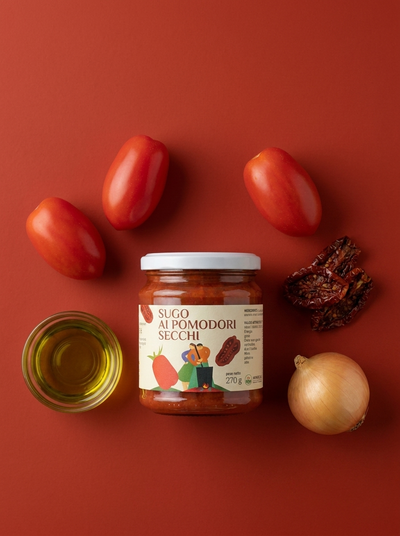
What do we actually need tomato paste for? A concentrated spoonful that gives sauces, stews and soups depth (it can even become an entire sauce). That exact role is filled by a product that gained its concentration not in your oven but under the southern Italian sun: Paté from sun-dried tomatoes — tomatoes dried by the sun, then worked into a spreadable paste with olive oil. Compared to tube paste it brings what the tube lacks: roasted notes, natural sweetness, oil-bound silkiness. A teaspoon in risotto, in a braise, or straight onto a crostino — the function of homemade estratto without spending August on your balcony.
Which concentrate for which job
- Tube paste: the neutral booster — sear, deglaze, done.
- Home-made oven concentrate: the connoisseur’s spice for special dishes.
- Paté from sun-dried tomatoes: the all-rounder with its own character — it seasons and shines solo.
Frequently asked questions
Why does my oven concentrate taste bitter? Too hot (above 110 °C it over-caramelises) or scorched bits were mixed in. Go low, go slow, turn often.
Can I freeze the paste? Brilliantly — freeze tablespoon-sized mounds on baking paper, then bag them: single-serve flavour coins for six months.
Is the project worth it with supermarket tomatoes? No. Concentration also magnifies blandness. Without fully ripe summer tomatoes (or excellent Passata) you will end up with expensive, pallid paste.