
Parmigiano and Jam: 6 Pairings That Elevate Aged Cheese
Parmigiano Reggiano and jam is a pairing Italian cuisine has codified for decades, but almost everyone gets it wrong for one reason only: they don't consider the ageing of the Parmigiano. An 18-month and a 36-month don't ask for the same jam — in fact, they ask for opposite things.
 | From our selection Welcome Kit (6 jars)Handmade, no preservatives. € 34,90 Discover → |
This is the map we use in guided tastings with restaurants that buy from Minnelea: six pairings, three ageings, one simple rule.
The rule: the more aged, the sweeter you need
Parmigiano Reggiano is aged by law for a minimum of 12 months, and is fire-branded after Consortium inspections. The three main commercial ageings are:
- 18-24 months: softer paste, sweet, milky. Few tyrosine crystals.
- 24-30 months: "intermediate" ageing. Granular paste, full flavour, crystals well present.
- 30-36 months and over: long ageing (also called "stravecchio"). Very intense flavour, dry, marked saltiness, notes of broth and dried fruit.
The rule, banal but always true:
The younger the Parmigiano (18-24), the more I want a tangy and fresh jam.
The more aged the Parmigiano (30+), the more I want a sweet and deep jam.
That's the foundation. Now into the detail.
Parmigiano 18-24 months: two pairings
1. Parmigiano 18 months + lemon marmalade
Young Parmigiano is the most misunderstood. It still has a strong milky sweetness, and putting an overly sugary jam on it (figs, for example) completely masks the structure. Extra lemon marmalade works instead: the acidity of the peel cuts the fattiness of the young paste and brings out the milk note. Serve in irregular small shards with a teaspoon of jam alongside. No honey.
When it works: spring aperitivo, cold antipasti, summer boards.
2. Parmigiano 18-24 months + red apple jam
The autumn variant. Extra red apple jam keeps a tangy note (red apple is less sugary than yellow apple) and a crunch of fruit pieces that stay in the mouth. Pairs well with young Parmigiano because it adds a perception of freshness without covering.
When it works: autumn board, after-dinner, before coffee.
Parmigiano 24-30 months: two pairings
3. Parmigiano 30 months + fig jam
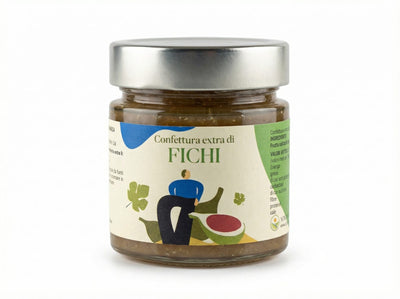
The "new classic". 30-month Parmigiano already has crystals well present and a full flavour. Extra white fig jam from Cilento (Dottato variety, whole fruit) has a deep, non-sugary sweetness, a slightly herbaceous note and those seeds that work very precisely on the granularity of the cheese. A small teaspoon, a not-too-thin shard.
When it works: working dinners, serious post-meal, boards all year round.
4. Parmigiano 30 months + traditional balsamic vinegar
The most "Italian" pairing of all, and here there's an important point. Traditional DOP balsamic vinegar (from Modena or Reggio Emilia, in a Consortium-certified ampoule) is not the same as IGP balsamic vinegar from Modena, which is what you find in any supermarket.
Only the DOP Tradizionale has the syrupy density and aromatic complexity to stand next to aged Parmigiano. IGP, on a shard of 30 months, is water and sugar. Price difference: €50-100 per 100 ml one, against €5-10 the other. The difference on the palate is enormous.
If you have the DOP: a few drops on thick shards, no jam alongside, it stands on its own. If you have IGP: skip it and use a jam, it'll be better.
Parmigiano 36 months (stravecchio): two pairings
5. Stravecchio Parmigiano + fig jam + mostarda
Stravecchio is the most intense Parmigiano on the market. High saltiness, notes of broth, dried fruit, dry on the palate. It asks for complex sugars, not simple ones. The winning combination is double: a teaspoon of fig jam and a small spoonful of mostarda (apple or pear). The mostarda adds the piquant note of mustard that cuts the saltiness.
When it works: serious tastings, premium gastronomic gifts, end of meal with sweet wine.
6. Stravecchio Parmigiano + walnuts and chestnut honey (note)
Chestnut honey is the only Italian honey that can stand up to stravecchio: bitter, dark, dense. Dose sparingly. For those who don't love honey, substitute with fig jam and a few shelled walnuts. It's the "Parma-style" closing of a serious board.
How much Parmigiano you need
On a board, Parmigiano is almost always the cheese people "overdo". Wrong: 25-30 grams per person of aged Parmigiano is generous, because the saltiness fills you up quickly. Better to have less and cut it into thick shards (half a centimetre), not into thin slices that crumble in your hand.
For cutting: the Consortium rule is "a punta" — with the drop-shaped knife that breaks the paste following the crystals. The regular shavings of uniform width you see at the supermarket are made with industrial blades and always taste more "anonymous" on the palate. Breaking the shard by hand is more correct, gastronomically.
What NOT to do
- Don't grate a 30 or 36 month to put on a board. Grated stravecchio is a waste: the aromatic complexity is lost in the first 30 seconds.
- Don't pair overly sugary jams with the 18 months. Peach jam, apricot jam, sweet mille-fleur honey: they cover.
- Don't serve Parmigiano cold from the fridge. Goes for all cheeses, but for Parmigiano in particular: take it out at least 1 hour before.
- Don't think "the more aged = always better". Many palates prefer 30 months over 36. The right ageing is the one you enjoy, not the highest number.
Summary table
| Ageing | Character | Ideal sweet pairing |
|---|---|---|
| 18-24 months | Milky, soft | Lemon marmalade |
| 24-30 months | Full, granular | Fig or red apple jam |
| 30 months | Intense, crystals | Fig jam or DOP balsamic |
| 36+ months | High saltiness | Figs + mostarda, or chestnut honey |
Where it starts
The extra Minnelea jams designed for Parmigiano:
- Extra lemon marmalade — for 18-24 month Parmigiano
- Extra red apple jam — for 18-24 month Parmigiano
- Extra white fig jam from Cilento — for 30 and 36 month